


Protect Royalties: Beat Licensing for U.S. Indies (8 Point Checklist)
A beat license grants specific usage rights over an instrumental. It does not usually transfer ownership. The core decision every buyer faces is a non-exclusive lease, which is cheaper and shared among multiple artists, versus an exclusive license, which hands one artist sole control at a higher price. Whichever path you choose, keep your license proof, set your metadata correctly, and register your splits with a performance rights organization before release.
TL;DR:
- Non-exclusive leases are the most common and affordable, but they allow multiple artists to legally use the same beat simultaneously.
- Exclusive licenses remove the beat from the market but do not retroactively cancel previous non-exclusive leases, which can cause licensing conflicts.
- Proper license management requires detailed metadata, registration with performance rights organizations, and proof of licensing to prevent royalty loss or legal issues.
- Content ID on YouTube generally only works with exclusive licenses, making non-exclusive leases risky for automated claims if multiple artists use the same beat.
- Producers should structure licenses clearly with specific terms covering file types, caps, territories, usage rights, and credit requirements to protect all parties.
Table of Contents
- What Is Beat Licensing and How Does It Differ From a Sale?
- Types of Licenses: Leases, Exclusives, Subscriptions, and Sync Rights
- How Do Royalties Split Between Producers and Artists?
- What Do License Tiers and Contract Terms Actually Cover?
- When Should You Choose an Exclusive License Over a Non-Exclusive Lease?
- Contract Checklist: What Every Beat License Should Include
- What Legal Risks Come With Using an Unlicensed Beat?
- How Should Producers Package, Price, and Deliver Licensed Beats?
- What Should Buyers Do to Protect Their License and Royalties?
- How Tellingbeatzz Structures Licenses for Independent Artists
- A Practitioner’s View on Treating Licenses as Collaborations
- Ready to License Your Next Beat?
- Where to Go for Official Licensing Information
- Sources
What Is Beat Licensing and How Does It Differ From a Sale?
Every finished song built on a licensed beat carries two separate copyrights, and understanding that split is the foundation of everything else in this guide. The first is the sound recording, known in the industry as the master. The second is the composition, the underlying melody and structure, which lives in the world of publishing. A producer who licenses a beat almost always retains ownership of the master recording of that instrumental, even after an artist has purchased the right to rap or sing over it. The U.S. Copyright Office’s resources for musicians confirm this dual structure, and it explains why producers are frequently credited as songwriters and can claim a share of composition royalties once a track is released commercially.
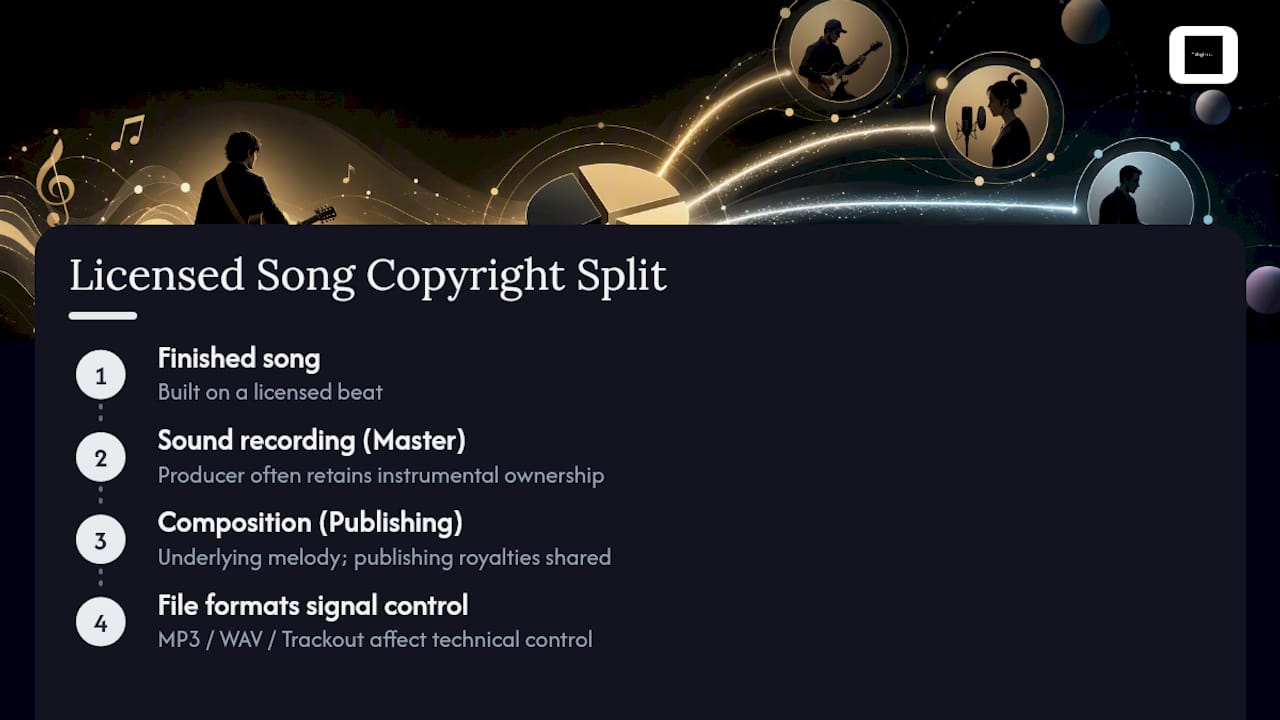
A license, in other words, is permission, not a deed. Buying a lease or an exclusive gives an artist the right to record, distribute, and monetize a song built on that beat under specific terms. It does not make the artist the owner of the beat itself. This distinction sits at the heart of industry guides like TuneCore’s beat licensing primer, which frames every standard agreement around usage rights rather than transfer of title.
File format matters here too, because it signals what level of creative control a buyer is actually getting. An MP3 lease hands over a compressed, mixed file suitable for streaming release but nothing more. A WAV lease delivers a higher fidelity file that mastering engineers prefer. A trackout (sometimes called stems) breaks the beat into its individual instrument layers, drums, bass, melody, so a mixing engineer can rebalance the entire record. Trackouts sit near the top of most pricing tiers precisely because they hand the buyer far more technical control over the final master, even though the underlying composition rights haven’t changed.
Types of Licenses: Leases, Exclusives, Subscriptions, and Sync Rights
Most beat marketplaces build their entire pricing structure around four license models, and each one answers a different question about how much control an artist actually needs.
Non-exclusive leases are the workhorse of the independent music economy. A producer can sell the same lease to dozens of different artists, and typical tiers scale by file type and rights included:
- Basic lease: MP3 file only, often capped at a set number of streams or sales, no trackouts.
- Premium lease: WAV plus MP3, higher or unlimited stream allowances, sometimes limited music video rights.
- Unlimited lease: WAV and trackouts, no distribution caps, broader sync allowances, still non-exclusive.
Exclusive licenses remove the beat from the market for everyone else going forward. Once sold, the producer generally stops offering that instrumental to new buyers. What exclusivity does not do, and this trips up a lot of first-time buyers, is retroactively cancel leases the producer already sold before the exclusive deal closed. If three artists leased that beat non-exclusively last month, their rights remain valid even after you buy the exclusive this month. TuneCore’s guide is explicit on this point, and it’s worth reading the fine print of any exclusive contract to confirm how the producer handles prior sales.
Subscription licensing has grown as a third model, particularly among prolific producers who move volume. These platforms standardize terms across every download, generating an automated license certificate the moment a subscriber grabs a file. The trade-off is flexibility: subscription terms tend to be non-exclusive by default, and Content ID options are usually off the table unless the platform offers a separate exclusive upgrade path, a structure the BeatPass licensing guide describes in detail.
Sync and master-use licenses operate on entirely separate terms from the beat marketplace models above. These agreements cover placement in film, television, advertising, or video games, and they’re negotiated case by case rather than sold off a price sheet. A sync deal usually requires clearance on both the master and the composition sides, which means the artist, the producer, and sometimes a publisher all need to sign off before a placement can move forward. Custom terms here are common, and platforms like Airbit’s creator resources note that many marketplaces now build tools specifically for negotiating these one-off sync exclusions.
How Do Royalties Split Between Producers and Artists?
Every dollar a song earns flows through one of two pipelines, and knowing which pipeline you’re standing in determines who gets paid.
Master royalties come from the sound recording itself, streaming payouts, physical sales, digital downloads. These flow to whoever owns the master, which is typically the producer for the beat and the artist for the finished vocal recording, split according to whatever the license agreement specifies.
Composition royalties (also called publishing) come from the underlying melody, chord progression, and lyrics. This is where writer’s share and publisher’s share come into play, and it’s the piece of the business that catches the most independent artists off guard.
- Writer’s share: paid to whoever actually wrote the composition, a category that often includes the producer if the beat contributed original melodic elements.
- Publisher’s share: paid to whoever administers the composition commercially, frequently the writer’s own publishing entity in an independent setup.
- Performance rights organizations (PROs) like ASCAP, BMI, and SESAC collect performance royalties from radio play, streaming, and live performance, then distribute the writer’s share and publisher’s share separately to each registered party.
- Mechanical royalties, generated whenever a composition is reproduced (streams, downloads, physical copies), flow through the Mechanical Licensing Collective (MLC) in the U.S., with the Harry Fox Agency (HFA) historically handling similar administration for specific catalogs.
Pro Tip: Register your split sheet with your PRO the same week you finish the record, not the week it drops. Performance royalties from radio and streaming can start accruing before distribution even fully processes, and a delayed registration means money sits unclaimed.
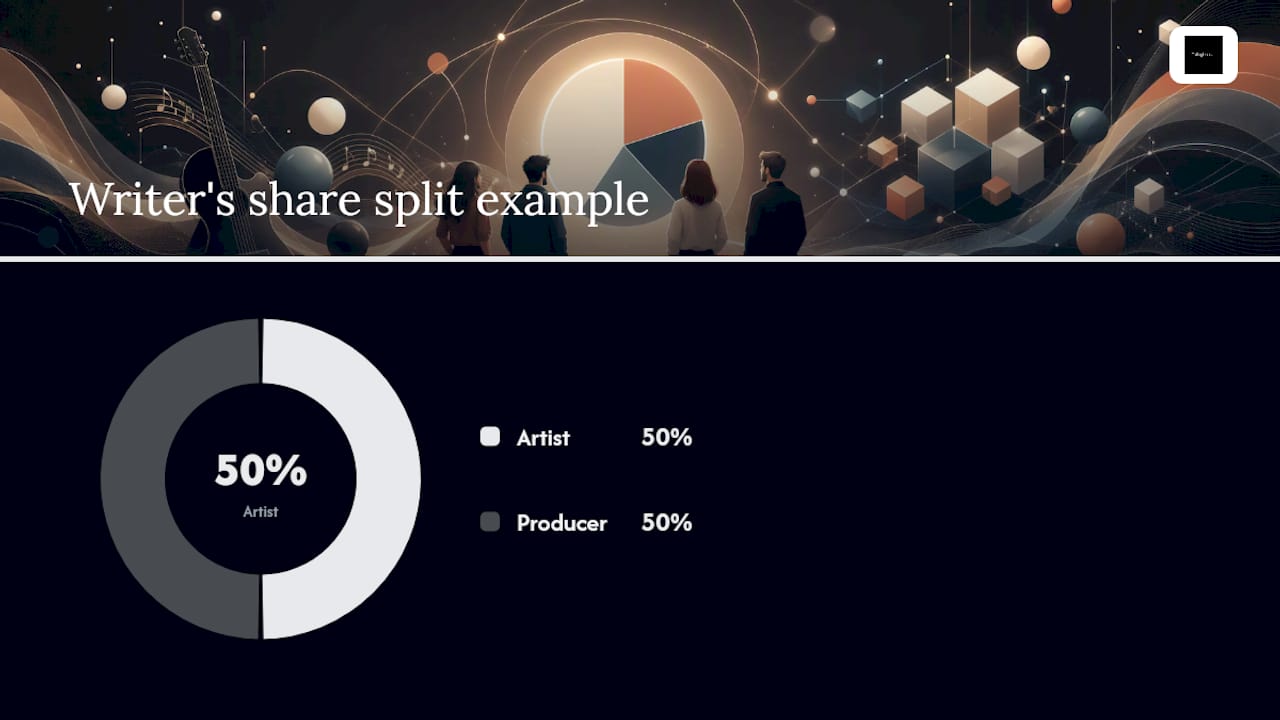
The Copyright Office’s musician resources confirm that producers who contribute to a composition are commonly credited as songwriters, entitling them to a writer’s share of publishing income on top of whatever the license fee covered. A typical independent split might look like 50% writer’s share to the artist and 50% to the producer if both contributed to the composition, though license agreements vary widely on this point.
What Do License Tiers and Contract Terms Actually Cover?
License agreements read like dense legal boilerplate until you know which five or six terms actually govern how you can use the beat. Once you know what to look for, most contracts take two minutes to parse.
- File types and stems. Confirms whether you’re getting MP3, WAV, trackouts, or some combination, and this single line determines your mixing flexibility down the road.
- Stream and distribution caps. Many leases cap streams (commonly somewhere between 2,000 and 100,000 depending on tier) or limit physical/digital copies sold, after which the license technically requires an upgrade.
- Music video and performance allowances. Some tiers permit a fixed number of monetized music videos; others restrict live performance income sharing.
- Territory and term. Most non-exclusive leases run worldwide with no expiration, but some producers write in a fixed term, so check for an end date buried in the fine print.
- Content ID eligibility. This is the tier feature that generates the most confusion among independent artists.
Content ID, YouTube’s automated rights-matching system, generally requires exclusive control over a beat to issue reliable claims. If a producer has leased the same beat to a dozen different artists non-exclusively, activating Content ID would flag every one of those legitimately licensed uploads as infringing, which is exactly backward. The BeatPass guide notes that most platforms restrict Content ID access to exclusive tiers specifically to avoid this conflict, so if a claim on YouTube matters to your release strategy, that requirement should shape your license choice from the start.
Metadata accuracy deserves its own line item here too. A license that lists the wrong producer name, an outdated beat ID, or an inconsistent title can delay royalty collection for months once a track hits a distributor. Treat metadata as part of the contract, not paperwork you fill out afterward.
When Should You Choose an Exclusive License Over a Non-Exclusive Lease?
The lease versus exclusive decision boils down to a handful of concrete triggers rather than a gut feeling, and running through them honestly before you buy saves both money and future headaches.
Start with your actual release goals. An artist testing a new sound, dropping a mixtape cut, or releasing music on a limited budget rarely needs exclusivity, because a non-exclusive lease covers standard streaming and download monetization at a fraction of the price. Exclusivity earns its higher price tag once specific conditions appear:
- You need reliable Content ID protection on YouTube, which typically requires exclusive control.
- You’re pursuing a sync placement in film, TV, or advertising, where the licensing party usually wants sole clearance.
- A label has expressed interest and wants confirmation the beat won’t surface on someone else’s competing release.
- The song is becoming central to your artist branding, and you don’t want the instrumental appearing under another act’s name.
Before buying anything, ask the producer directly: how many leases have already sold on this beat, does the exclusive option retroactively affect those buyers, what file formats come with each tier, and does the price include any publishing split. A five-minute conversation up front resolves the disputes that otherwise surface six months later when a song starts climbing the charts.
Contract Checklist: What Every Beat License Should Include
A usable beat license needs a specific set of fields present, regardless of whether it’s a one-page digital agreement or a formal contract drafted by a lawyer.
- Identifying information. Full legal names (or registered business names) of both producer and artist, plus contact details for royalty payments.
- Beat identification. Title, BPM, key, and a unique beat ID or catalog number, so there’s no ambiguity about which instrumental the contract covers.
- License type and tier. Explicitly state non-exclusive or exclusive, and name the specific tier (basic, premium, unlimited) with its included file formats.
- Permitted uses. Streaming, download sales, music videos, live performance, sync, each use case should be spelled out rather than assumed.
- Term and territory. Duration of the license and geographic scope, worldwide is standard but not universal.
- Payment and royalty splits. Purchase price, any ongoing royalty percentage, and which party is responsible for issuing a mechanical license if the song sees mechanical reproduction.
- Credit requirements. The exact production credit wording the artist must use (for example, “Produced by [Name]”) in liner notes and streaming metadata.
- Termination and overage terms. What happens if stream caps are exceeded, and whether exceeding a cap requires an upgrade purchase or voids the agreement.
Industry templates from marketplaces like TuneCore converge on nearly identical structures, which tells you these fields aren’t optional extras. They’re the baseline any professional agreement needs to hold up if a dispute ever reaches a royalty audit or a legal review.
What Legal Risks Come With Using an Unlicensed Beat?
Releasing a song over an unlicensed beat is one of the fastest ways to lose control of your own release. Streaming platforms and YouTube both run automated matching systems, and an unlicensed use can trigger a DMCA takedown within days of upload, stripping the track from distribution and erasing any accumulated streams or revenue. Beyond the takedown itself, the original rights holder can pursue a monetary claim for damages, and disputed revenue on a track that was actually generating income only compounds the loss.
Content ID adds a second layer of complexity worth understanding on its own terms. Because non-exclusive leases permit multiple artists to use the same beat legally, activating a Content ID claim against one licensee’s upload risks flagging every other legitimate licensee too, a structural conflict that’s why most platforms restrict Content ID access to exclusive tiers in the first place.
One legal wrinkle that surfaces in producer forums more than it should is Section 203 of the Copyright Act, the so called 35-year termination rule.
Section 203 allows an author to terminate a prior transfer or exclusive license 35 years after it was executed, reclaiming rights that had previously been assigned away. The mechanics are notoriously intricate, requiring precise notice windows and filing procedures, and the statute itself lays out strict timing rules that make it a poor fit for casual assumptions.
For the overwhelming majority of independent producers and artists working with standard non-exclusive leases, this rule simply doesn’t apply, since leases aren’t the kind of long-term transfer Section 203 targets. It becomes relevant mainly in exclusive sales or formal assignments of composition rights, the kind of deal a growing artist might sign with a publisher decades into a career.
How Should Producers Package, Price, and Deliver Licensed Beats?
Selling beats professionally comes down to three habits: consistent tiering, clean metadata, and registering your publishing before a track has any chance to blow up.
Start with pricing structure. Most independent producers set non-exclusive leases across three or four tiers, with pricing that climbs alongside the rights included, and reserve exclusive sales for a meaningfully higher price point that reflects the beat’s permanent removal from the market. There’s no single correct number here, since pricing depends heavily on a producer’s catalog size, reputation, and genre, but the tier structure itself should stay consistent across a catalog so buyers know what they’re comparing.
- Tag every file with a clear naming convention: producer name, beat title, BPM, and key, ideally in the filename itself.
- Include a split sheet template with every exclusive sale so the artist has proof of publishing agreement from day one.
- Assign an ISRC to any beat that will see significant sync or radio submission, since it simplifies tracking across platforms.
- Keep a dated record of every lease sold on a given beat, useful both for your own records and for resolving future exclusivity disputes.
Pro Tip: Register your compositions with your PRO the moment you finish a beat that includes original melodic writing, not after an artist licenses it. Registration doesn’t cost you future flexibility, and it means you’re already in the system when royalties start flowing.
Filing your writer’s share registration with the U.S. Copyright Office and your PRO ensures publishing income actually reaches you once a licensed track starts generating airplay or streams. Skipping this step is the single most common reason producers miss out on royalties they were legally entitled to collect.
What Should Buyers Do to Protect Their License and Royalties?
Buying a license is only step one. Protecting the rights that license grants requires a bit of ongoing diligence that most first-time buyers skip.
- Save the license PDF and payment receipt the moment you complete a purchase, and store them somewhere permanent, not just in an email you might delete.
- Enter the producer’s credit exactly as written in the license when you upload to a distributor, since inconsistent metadata slows royalty matching.
- Register your writer’s share of the composition with a PRO as soon as the track is finished, well before release day if possible.
- File for mechanical royalty collection through the appropriate agency once the song is available for streaming or download.
- Avoid activating Content ID on a non-exclusive beat unless your specific license grants that right, since doing so risks filing a false claim against another artist who licensed the same instrumental legally.
Keeping these records isn’t just defensive paperwork. It’s what turns a purchased license into an income stream you can actually collect on when a track performs better than expected.
How Tellingbeatzz Structures Licenses for Independent Artists
The catalog is built around the same lease and exclusive structure this guide has walked through, offering MP3, WAV, and full trackout options across its tiers. The approach includes the ability to build a personalized beat pack rather than buying one instrumental at a time, with every pack carrying unlimited commercial rights so artists aren’t left guessing about stream caps or upgrade triggers later.
That transparency matters most once a release starts to perform. Tracks built on instrumentals from this platform have generated over 200 million streams collectively, and the licensing terms are written to keep pace with that kind of growth rather than forcing an artist back to the negotiating table. For a deeper look at how producer credit and publishing splits typically work on licensed tracks, the Tellingbeatzz blog covers the mechanics in more detail, alongside artist case studies on the Hip Hop Blogs archive.
A Practitioner’s View on Treating Licenses as Collaborations
The healthiest way to think about a beat license is as the start of a working relationship, not a one-time transaction that ends at checkout. Producers and artists who exchange metadata, split sheets, and contact information immediately after a purchase tend to avoid the messiest disputes down the line, the ones that surface only after a song has already found an audience. Communication early costs nothing. Communication after a track blows up costs goodwill, legal fees, and sometimes the relationship itself.
If a release outperforms what either party expected, whether it lands sync interest or catches a label’s attention, revisit the license terms like professionals. A producer who originally sold a lease can often be approached about an exclusive upgrade, and most will welcome that conversation when it’s handled directly and fairly. Beat licensing works best when both sides treat the paperwork as a shared investment in the song’s future, not a boundary to be tested.
— Thomas
Ready to License Your Next Beat?
This platform gives independent artists something most producer marketplaces don’t: a catalog where every license, whether it’s a starter lease or a full buyout, comes with unlimited commercial rights spelled out from the first click, no stream caps to track and no upgrade renegotiation waiting six months down the line.
That clarity is the whole point. Instead of parsing tier fine print or guessing whether your growing stream count just triggered a hidden cap, you know your rights the moment you download the file. Browse the full catalog of beats to find a sound that fits your next release, or build a personalized beat pack across genres if you’re working on a project that needs range. Every purchase delivers instantly in MP3, WAV, or trackout format depending on your tier, so you can get straight to recording instead of waiting on file transfers.
Where to Go for Official Licensing Information
For registration mechanics, start with the U.S. Copyright Office’s musician resources and its registration circular. Section 203 termination details live in 17 U.S.C. §203. For broader context on licensing-as-permission concepts, Temple of Sound’s industry piece offers useful background reading.
No Comments