

85–95 BPM Boom Bap: Tempo, Swing, and Mixing for Producers
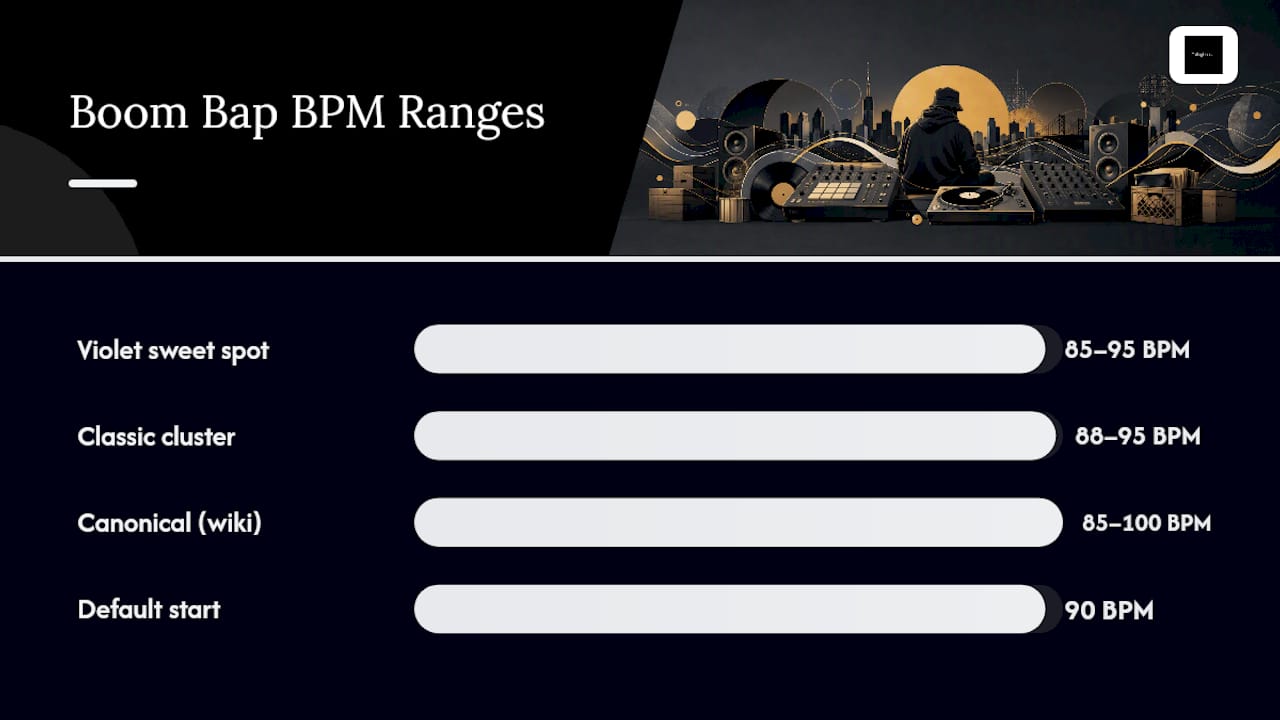
Boom bap typically lives within a tempo range around the mid-80s to mid-90s BPM, with 90 BPM being a common starting point for producers. That single number carries the genre’s head-nod pocket, the space between kick and snare that makes a beat breathe. Set your project there, then trust your ear to nudge it a few clicks in either direction once the drums and sample start talking to each other.
TL;DR:
- The ideal boom bap tempo range is between 85 and 95 BPM, with 90 BPM serving as the standard starting point to balance momentum and vocal phrasing.
- Most classic records cluster around 88 to 95 BPM, and tempo heavily influences groove, vocal delivery, and sample chopping for authentic feel.
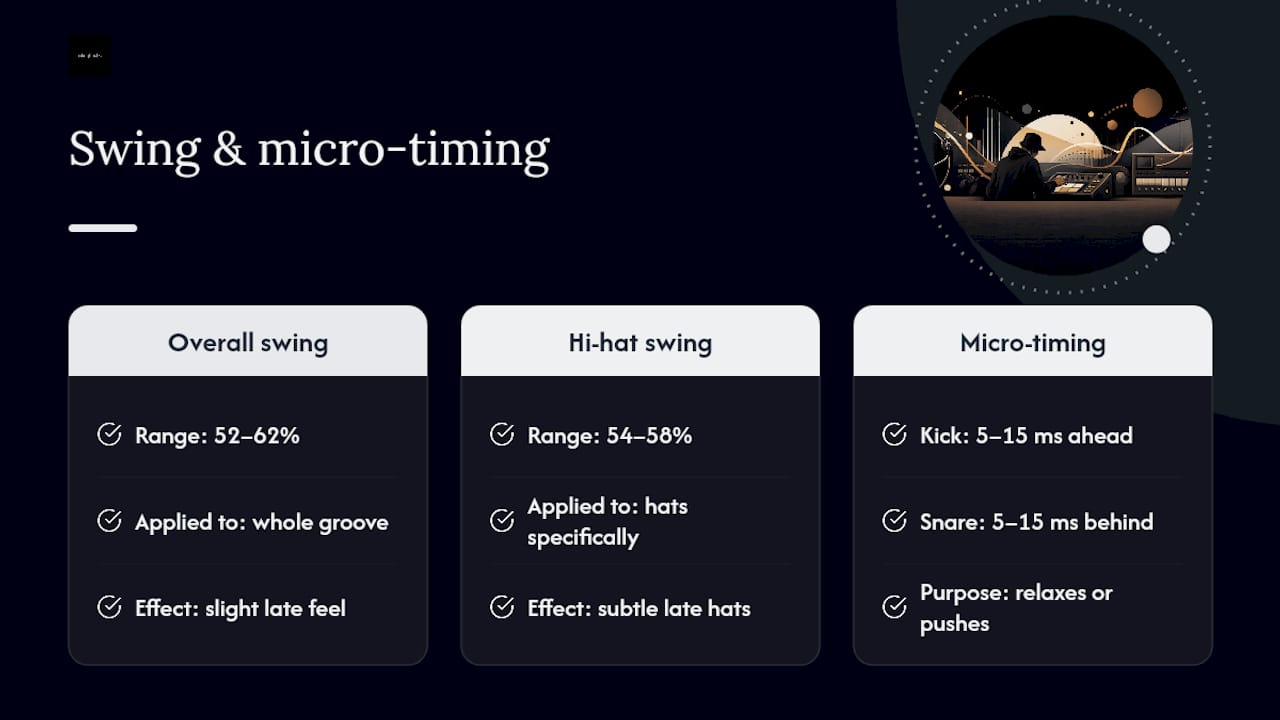
- Swing settings should be between 52% and 62%, with micro-timing nudges of five to fifteen milliseconds enhancing the groove at these tempos.
- Starting at 90 BPM allows easy adjustment for different vocal styles or samples, making it a reliable anchor for mid-tempo boom bap production.
- Listening to reference tracks and using tempo-tagged beat packs helps producers internalize the feel and select the right BPM for their project.
Table of Contents
- Why Boom Bap Lives in the 85–95 BPM Range
- Boom Bap Songs and Their Typical BPMs
- Swing, Quantize, and the Boom Bap Pocket
- Programming Boom Bap Drums Step by Step
- Mixing Boom Bap at Mid-Tempo Ranges
- Why 90 BPM Earns Its Reputation as the Default
- Another Way to Test Tempo: Tempo-Tagged Beat Packs
- Sources
Why Boom Bap Lives in the 85–95 BPM Range
Boom bap’s tempo isn’t arbitrary. It’s the range where a kick and snare can sit far enough apart to create negative space, that pause between hits where the groove actually lives. Push much past 95 BPM and the pocket tightens into something closer to a trap cadence. Drop below 85 and the beat starts to drag rather than nod.
The Producer’s Bible at MusicProductionWiki places the canonical range at 85 to 100 BPM, with most classic records clustering tighter, around 88 to 95 BPM, and 90 BPM serving as the default starting point for a reason: it’s fast enough to carry momentum but slow enough to leave room for swung hats and a rapper’s phrasing to stretch across the bar. Violet Recording’s production guide narrows that further, calling 85 to 95 BPM the sweet spot and 90 BPM the genre’s “head-nod” tempo, the point where your body moves before your brain decides to.
Vocal cadence matters here too. Boom bap rap tends to favor deliberate, syllable-heavy phrasing, and a mid-tempo beat gives an MC room to land words without racing the pocket. Sample choice follows the same logic. Slower soul and jazz loops chop cleanly at these tempos without sounding stretched or artificial.
Exceptions exist. Some golden-era producers, including work associated with Wu-Tang’s camp, dip into the low 80s for a heavier, more menacing feel. Treat that as a deliberate aesthetic choice, not the norm.
Boom Bap Songs and Their Typical BPMs
Nothing teaches tempo faster than listening to records that already nail it. Here’s a working list of boom bap and boom bap-adjacent tracks, grouped loosely by era, that sit inside or near the canonical band:
- “N.Y. State of Mind” by Nas — around 90 BPM; the kick is heavy but never rushed, a textbook head-nod pocket.
- “The Message” by Nas — sits near 92 BPM; notice the vocal phrasing stretching just behind the beat.
- “Shook Ones, Pt. II” by Mobb Deep — close to 95 BPM, on the faster edge of the range, with a tighter hat pattern to match.
- “Award Tour” by A Tribe Called Quest — hovers around 93 BPM; the bass line and swing work together to create bounce without speed.
- “They Reminisce Over You” by Pete Rock & CL Smooth — closer to 88 BPM, slower and more reflective, built for a laid-back sample loop.
- “Ex Girl to Next Girl” by Mobb Deep — around 90 BPM, a clean reference for classic swing.
- Modern revival tracks from artists leaning into 90s-style boom bap production tend to stay in that same 88 to 95 BPM band, often tagged that way on curated listening collections like the boom bap instrumental playlists on Spotify.
Pick one reference track close to your target tempo, loop it in your DAW alongside your own draft, and compare where your kick lands against theirs. That comparison will tell you more about feel than any metronome will.
Swing, Quantize, and the Boom Bap Pocket
Tempo sets the frame, but swing and quantize settings decide whether a beat actually nods or just plods. At 85 to 95 BPM, a straight, fully quantized grid feels stiff. Boom bap needs deliberate imperfection.
The MusicProductionWiki production reference recommends overall swing settings between 52% and 62%, with hats specifically dialed to 54% to 58%. That range pushes off-beat hits slightly late without throwing the groove off balance.
Micro-timing matters as much as swing percentage. Nudge your snare a few milliseconds behind the grid, and the beat relaxes. Nudge the kick slightly ahead, and it pushes forward with more urgency. Small moves, five to fifteen milliseconds, make an outsized difference at these tempos because there’s more space between hits for the ear to notice timing.
Pro Tip: Turn off quantize entirely for one pass and play your hat pattern live with a MIDI controller at 90 BPM. Even rough, human timing often beats a perfectly swung preset because your hand naturally leans into the pocket a machine setting can only approximate.
Try the same drum pattern at 88, 90, and 93 BPM with identical swing settings. You’ll hear how the same percentage feels tighter or looser depending on tempo.
Programming Boom Bap Drums Step by Step
Building a boom bap beat at the right tempo follows a repeatable sequence. Here’s a workflow you can copy directly into your session.
- Set your DAW tempo first. Start at 90 BPM before you touch a single drum hit or sample. Committing to tempo early keeps every chop and loop locked to the right grid from the start.
- Chop and place your sample. Import your soul, jazz, or funk loop and time stretch or chop it to match your tempo. Boom bap sample chopping works best when the loop’s natural swing survives the edit rather than getting quantized away.
- Program kick, snare, and hats. Place the kick and snare with real space between them, then layer eighth or sixteenth note hat subdivisions depending on how busy you want the top end. At 85 to 95 BPM, sixteenth-note hats with occasional triplet fills tend to fill the pocket without crowding it.
- Apply swing and add low end. Dial in your 52% to 62% swing, then bring in a sub-bass layer that follows the kick’s rhythm rather than competing with it.
- Arrange with tempo in mind. Build your intro, verse, and hook sections around subtle variation, swap a hat pattern, drop the kick for four bars, rather than tempo changes. Boom bap stays in one tempo lane; the arrangement carries the movement instead.
Mixing Boom Bap at Mid-Tempo Ranges
Mixing decisions shift depending on tempo, and boom bap’s mid-range speed calls for specific choices on the drum bus and beyond.
Compression on the drum bus should lean toward slower attack times, letting the initial transient of the kick punch through before the compressor clamps down. A ratio around 3:1 to 4:1 with a medium release tends to preserve punch without flattening the groove that swing settings just created. Light saturation on the bus adds warmth that mimics the sound of sampled vinyl without needing an actual sample.
EQ work should protect low-mid clarity. High-pass the kick around 30 to 40Hz to remove rumble while keeping its weight, and carve a small dip around 300 to 500Hz on both kick and vocal to avoid mud building up at mid-tempo, where sustained low frequencies have more time to ring out before the next hit.
Reverb pre-delay matters more here than in faster genres. A pre-delay of 20 to 40 milliseconds on snare reverb keeps the initial hit crisp before the tail blooms, which matters when there’s real space between hits to fill. Keep mastering headroom generous, roughly negative 6 to negative 8 LUFS integrated, to preserve the dynamic punch that defines the genre rather than squashing it flat.
Why 90 BPM Earns Its Reputation as the Default
Ninety BPM works as a starting point because it splits the difference between two tendencies producers fall into: rushing a beat to sound energetic, or slowing it down until it loses its bounce. Starting at 90 gives you room to move five clicks in either direction and still land inside the range that defines the genre.
The real skill isn’t in picking the number. It’s knowing when to abandon it. A beat built for a slower, more deliberate rapper might land better at 87. A track meant to feel a little more urgent, closer to the boom bap and drill boundary, might sit better at 94. Treat 90 BPM as a reliable anchor, not a rule carved in stone, and let the vocal cadence or sample groove tell you when to nudge away from it.
— Thomas
Another Way to Test Tempo: Tempo-Tagged Beat Packs
Reading about BPM ranges only gets you so far. At some point, you need to hear finished instrumentals at 88, 90, and 93 BPM side by side to feel the difference for yourself. That’s where Tellingbeatzz fits into your workflow.
A platform gives independent artists and producers access to hundreds of instrumentals, many built specifically in the boom bap pocket, with the option to build custom beat packs under unlimited commercial rights. Instead of guessing whether 90 BPM or 93 BPM fits your voice, you can audition real, finished tracks across that range and hear how swing, sample choice, and tempo interact in a fully mixed beat rather than a rough draft. Some purchases include instant download in MP3, WAV, or full trackout formats, so you can drop a beat straight into your session and start writing. If you’re ready to stop theorizing about tempo and start working with it, browse boom bap instrumentals at Tellingbeatzz and pull a few tracks into your own reference library today.
Sources
The Producer’s Bible at MusicProductionWiki offers the deepest breakdown of canonical tempo ranges and swing parameters. Violet Recording’s guide covers practical DAW workflow. SampleFocus’s tempo guide compares boom bap to other hip-hop subgenres, and the Se7en BPM Index provides a quick-reference tempo summary.
No Comments