

Exclusive vs Nonexclusive Beats: What Every Artist Should Know
Exclusive means you buy sole future use of a beat, and the producer stops selling it to anyone else. Non-exclusive means you license permission to use a beat while the producer keeps selling it to other artists. Neither choice includes an automatic transfer of copyright unless a separate document says so.
For most independent artists building a catalog, the practical move is to lease non-exclusive beats early and often, then reserve exclusive purchases for the songs that matter most.
- Exclusive: sole future rights to the beat, usually with stems and trackouts included, priced to reflect what the producer gives up in future lease sales.
- Non-exclusive: shared usage rights at a lower price, typically tiered by stream caps, file format, and distribution limits.
- The quick rule: lease to test a record’s traction; buy exclusive when a single needs label attention, sync placement, or full Content ID monetization.
Key Takeaways
Exclusive beats grant sole future usage rights at a premium price, while non-exclusive leases offer shared, tiered access at a fraction of the cost.
| Point | Details |
|---|---|
| License types differ by scope | Exclusive stops future sales of the beat; non-exclusive allows the producer to keep selling it. |
| Copyright needs a separate document | Buying exclusive rights doesn’t transfer composition copyright unless a written assignment says so. |
| Publishing splits affect income | Producers often retain a composition share or negotiate points, typically in the 1% to 10% range. |
| Upgrades don’t erase prior licenses | Earlier non-exclusive buyers keep their rights even after someone else buys the exclusive. |
| Tellingbeatzz shows terms upfront | Clear license PDFs and build-your-pack options make lease-versus-exclusive decisions easier to compare. |
Primary sources and further reading
- Copyright Basics (Circular 9) — U.S. Copyright Office
- Beat licensing 101 — TuneCore
- Choosing the Right License For Your Beat — UnitedMasters
- Beat leasing vs exclusive rights: complete producer guide — Feedtracks
- Beat leasing vs exclusive rights — Tools4Music
Table of Contents
- Exclusive vs Nonexclusive Beats: The Actual Deliverables
- Who Owns the Master, the Composition, and the Publishing?
- What Do Exclusive and Nonexclusive Beats Actually Cost?
- When Should You Lease Versus Buy Exclusive Rights?
- Can You Upgrade a Lease to Exclusive Later?
- Your Pre-Purchase Checklist for Beat Licensing
- Sources
Exclusive vs Nonexclusive Beats: The Actual Deliverables
The difference between these two licenses shows up first in the files you receive and the limits attached to them. A basic non-exclusive lease often includes only an MP3, capped at a set number of streams or sales. Step up a tier and you’ll typically get a WAV file with a higher or unlimited cap. Exclusive purchases almost always include stems or trackouts, the isolated instrument and drum layers a mix engineer needs for a proper master.
Common deliverables across tiers look like this:
- MP3 lease: entry-level tier, often capped around a few thousand streams or limited units sold.
- WAV lease: better audio quality, usually a higher cap or unlimited streaming.
- Trackout/stems lease: premium non-exclusive tier with full stems, still shared with other buyers.
- Exclusive: sole ownership of usage rights going forward, nearly always bundled with stems, trackouts, and sometimes session files.
Tiered structures like this appear across most producer marketplaces, and UnitedMasters’ license guide confirms the pattern: exclusive deals typically cost more and carry broader distribution rights, while non-exclusive tiers stay capped and priced for volume. One distinction gets lost in casual conversation: an exclusive license grants sole usage rights, not necessarily copyright ownership. Those are two different legal events, and only a written assignment accomplishes the second one.
Who Owns the Master, the Composition, and the Publishing?
A beat carries two separate copyrights: the sound recording (the master) and the underlying composition. The U.S. Copyright Office’s Circular 9 treats these as distinct works, and your contract, not the license type, decides who registers and controls each one.
What this means for your publishing: most marketplace exclusives transfer usage rights to the beat but leave the producer holding the composition copyright unless the contract explicitly assigns it. That distinction determines your writer’s share.
If the producer keeps composition rights, they’re usually entitled to a portion of your publishing income, often structured often as an equal or similar split on the underlying music. On top of that, producers sometimes negotiate points, a small percentage of royalties or profit, especially for beats attached to a song that starts generating real revenue. Points are more common on exclusive deals with recognized producers than on cheap non-exclusive leases, where the transaction is closer to a flat-fee rental.
What Do Exclusive and Nonexclusive Beats Actually Cost?
Price bands vary widely by producer reputation, but the market has settled into recognizable ranges:
- Non-exclusive MP3 leases: often the cheapest tier, priced for testing songs without much financial commitment.
- Non-exclusive WAV/trackout leases: a step up, usually justified by higher caps and better audio.
- Exclusive rights: the largest jump, since the producer is giving up every future lease sale on that beat.
According to Feedtracks’ producer guide, producers are advised to set exclusive prices high enough to offset the recurring income they’d otherwise earn from repeat non-exclusive sales. One practical heuristic circulating among producers sets exclusive pricing at several times the non-exclusive lease price, depending on how well the beat has historically sold. That’s a rule of thumb, not a formula every producer follows, but it explains why a beat that’s been leased dozens of times commands a much higher exclusive price than a fresh instrumental nobody has touched yet.
Stream and distribution caps matter here too. Cross a cap and you’re technically out of compliance, which usually forces an upgrade rather than a penalty, but it’s still a contract breach worth avoiding.
When Should You Lease Versus Buy Exclusive Rights?
The choice usually comes down to what the song is for, not just your budget. Run through these scenarios before you decide:
- Testing a new sound or releasing frequently? Lease non-exclusive. Low cost, fast turnaround, and no long-term commitment while you find out what resonates.
- Building a playlist pitch or algorithm-driven single? Lease first. If it gains traction, you can often negotiate an upgrade to exclusive later.
- Planning a flagship single with ad spend, label conversations, or sync licensing in play? Buy exclusive. You need sole rights to avoid another artist releasing over the same instrumental mid-campaign.
- Need full YouTube Content ID monetization? Exclusive rights are typically required, since non-exclusive beats usually can’t be registered without risking a false claim.
Pro Tip: Run a quick breakeven check before buying exclusive: estimate your expected streams, multiply by your per-stream revenue, and compare that number against the exclusive price. If the math doesn’t clear the cost within a realistic release window, lease instead and revisit exclusivity once the song proves itself.
Can You Upgrade a Lease to Exclusive Later?
Exclusivity is forward-looking. Buying exclusive rights typically stops the producer from selling that beat to anyone new, but it doesn’t erase licenses already sold. According to TuneCore’s licensing guide, earlier non-exclusive licensees generally keep the rights they already paid for, even after someone else buys the exclusive.
This matters directly for Content ID. Non-exclusive licenses usually can’t be registered for monetization, since multiple artists may be using the same instrumental, and Content ID exists to flag unauthorized use, not shared licenses.
Before you upgrade:
- Ask for written disclosure of every prior non-exclusive sale on that beat.
- Confirm whether the beat is currently Content ID registered or eligible.
- Negotiate price and credit terms based on how many times the beat has already been leased.
Your Pre-Purchase Checklist for Beat Licensing
Copy this into an email before you commit to any license:
- Exclusivity scope — Does this remove the beat from sale entirely, or just from new non-exclusive tiers?
- Prior leases — How many times has this beat been leased, and to whom?
- Term, caps, and territory — Is the license perpetual or time-limited, and does it cover worldwide distribution?
- File formats — Are stems and trackouts included, or sold separately?
- Publishing and points — Does the producer retain a composition split or royalty percentage?
- Content ID policy — Is the beat currently registered, and does the license address that?
- Refund and upgrade terms — Can you upgrade later, and at what cost?
Pro Tip: Ask directly: “Can you confirm in writing whether this beat has been sold non-exclusively before, and whether Content ID is currently active on it?” A producer who answers immediately and specifically is one worth trusting with your next release.
Tellingbeatzz structures its listings around exactly these questions, showing licensing terms plainly rather than burying them in fine print, which is the standard every beat store should be held to.

A pragmatic approach for independent artists
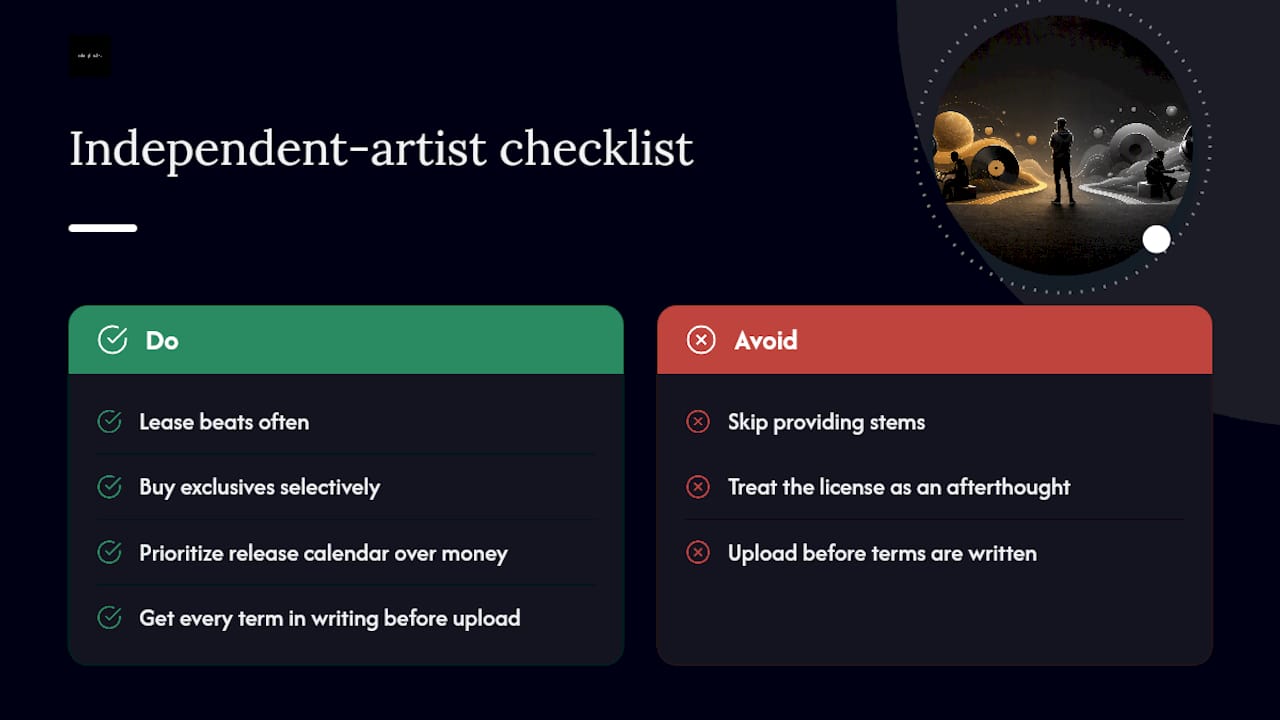
If you’re building a catalog on a real budget, lease often, buy exclusive selectively, and never skip the stems. Prioritize your release calendar first, your money second, and treat the license itself as part of your business plan, not paperwork you sign after the fact. Get every term in writing before you upload a single file to a streaming platform.
— Thomas
How Tellingbeatzz Makes Licensing Decisions Easier
Tellingbeatzz gives you both routes, non-exclusive and exclusive, without the vague terms that make so many beat stores frustrating to negotiate with.
Every listing includes clear license PDFs that spell out caps, formats, and rights up front, so you’re not guessing what you’re paying for. You get instant downloads in MP3, WAV, and trackout formats depending on the tier, and if a single track isn’t enough, you can build a custom beat pack with unlimited commercial rights across every beat you select. That clarity matters most when you’re negotiating publishing splits or checking Content ID status. A vague license creates disputes later. A clear one, the kind Tellingbeatzz builds every listing around, gives you and any collaborator, label, or distributor the same understanding from day one. If you’re ready to stop guessing at fine print, browse available beats and licensing tiers and pick the option that fits your next release.
Sources
- Copyright Basics (Circular 9) — U.S. Copyright Office
- Beat licensing 101 — TuneCore
- Choosing the Right License For Your Beat — UnitedMasters
- Beat leasing vs exclusive rights: complete producer guide — Feedtracks
- Beat leasing vs exclusive rights — Tools4Music
No Comments