

GEMA vs GVL: What Independent Artists in Germany Must Know
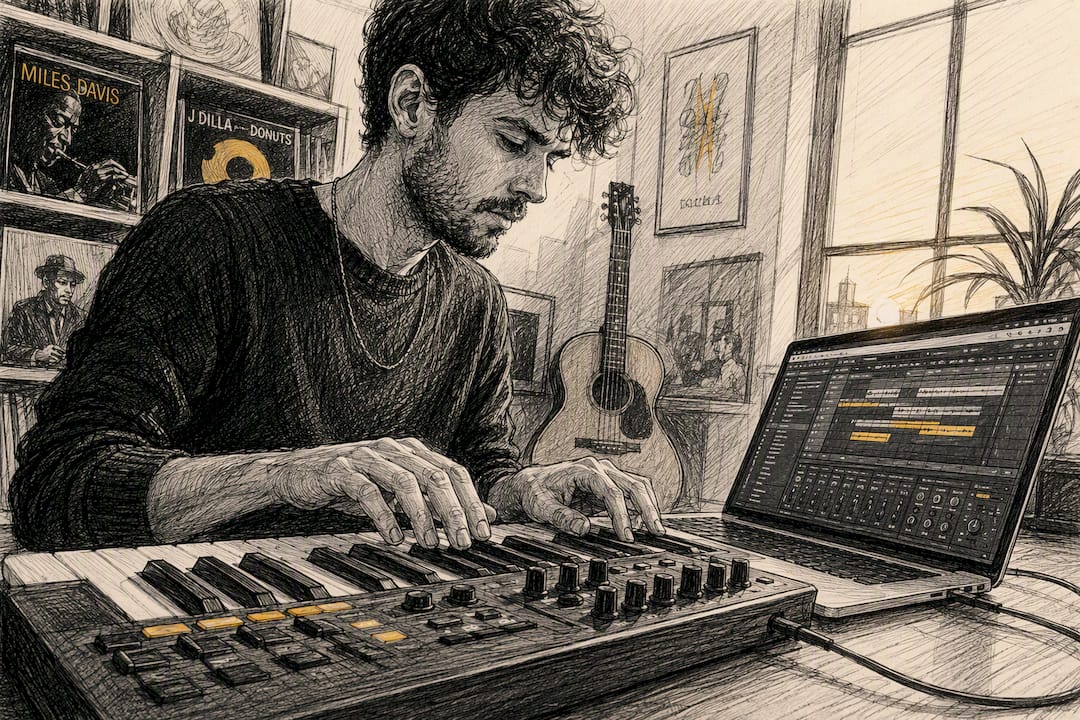
Hands on MIDI keyboard in home studio

GEMA vs GVL: What Independent Artists in Germany Must Know

GEMA covers composers, lyricists, and publishers. GVL covers performers, producers, and labels. If you write a song and record it, you likely need to register with both societies to get paid in full. Miss one, and you leave royalties on the table that nobody else will collect for you.

Here’s the short version for a self-released hip-hop track: as the writer of the lyrics and melody, your composition rights sit with GEMA. As the performer and, if you released it under your own name, the producer of the master recording, your neighboring rights sit with GVL. Two roles, two societies, two separate registrations.

Do these two things this week:

  • Confirm who legally holds the composition (author, co-writer, publisher) and prepare that metadata for GEMA.
  • Gather your license documents and recording details so you can register the master and performer claims with GVL.

Pro Tip: Treat composition and master rights as two different products from day one. Even if you wrote, performed, and produced the same track, you wear two separate hats in the eyes of German copyright law.

Key Takeaways

Independent artists in Germany typically need both GEMA and GVL registered correctly to collect the full royalties their music generates.

Point Details
Two separate registrations Register your composition with GEMA and your performer or producer role with GVL.
Web radio needs both Streaming or background-music operators generally must license through GEMA and GVL simultaneously.
Get a Label Code Obtain a GVL-assigned Label Code before pursuing radio airplay in Germany.
File splits before release Declare author and publisher shares with GEMA ahead of release to avoid later disputes.
Start with clean licensing Tellingbeatzz’s licensed beats include the metadata artists need to register compositions and masters without ambiguity.

Table of Contents

GEMA vs GVL: What Each Society Actually Covers

The confusion around GEMA vs GVL almost always comes down to one thing: people assume one society represents “the song” while the other doesn’t matter unless you’re famous. That’s wrong on both counts.

GEMA represents composers, lyricists, and music publishers. It manages performing rights (when your composition is played live, broadcast, or streamed) and mechanical rights (when it’s reproduced on a physical or digital format). GEMA acts as a fiduciary trustee, not a profit-making company, and it distributes collected royalties according to a distribution plan set democratically by its General Assembly. It represents more than 100,000 members directly and administers rights for over two million rightsholders worldwide through reciprocal deals.

GVL represents a different set of people entirely: performers, producers, and labels. Its domain is neighboring rights, sometimes called related rights, which cover the specific recording rather than the underlying composition. GVL also assigns the Label Code (LC), a short numeric identifier that broadcasters use to correctly attribute airplay to the right label or artist.

Here’s how that plays out in practice:

  • A live show: the venue or promoter typically pays GEMA for the right to perform your composition publicly.
  • A streaming release: the DSP pays mechanical and performance royalties to GEMA for the composition, and neighboring-rights royalties to GVL for the recording and performance.
  • Club play: GEMA collects for the composition being performed publicly; GVL collects for use of the specific recording.
  • Radio airplay: both societies get involved, and your Label Code becomes essential for GVL to track and pay out correctly.

The overlap is intentional, not redundant. GEMA and GVL cover different legal interests in the same three minutes of music, which is exactly why so many independent artists in Germany end up needing both.

When Do You Actually Need Both Licenses?

Not every activity triggers both societies. Here’s how the common scenarios break down for independent artists working in Germany.

  1. Releasing to streaming platforms. Your composition royalties flow through GEMA once your work is registered with correct authorship and publishing splits. Your master and performer royalties flow through GVL, but only if you’ve registered as a performer or producer there separately. Skip GVL registration, and DSP-driven neighboring-rights income simply goes uncollected.

  2. Playing a live gig or festival. The venue or promoter usually holds a GEMA license and pays a fee based on the event. GVL rarely enters this picture directly unless the performance is broadcast or streamed.

  3. Running web radio, a podcast with music, or a business with background music. According to GVL’s guidance, this is where both societies are almost always required simultaneously. GVL’s webcasting tariff distinguishes commercial from non-commercial services and typically bills quarterly, so budget for recurring invoices, not a one-time fee.

  4. Sync licensing for video or advertising. Clearing a track for sync means negotiating two separate permissions: the composition (publisher and GEMA-registered author) and the master (whoever owns the recording, cleared through direct negotiation, with GVL entitlements following separately for the performers involved).

Each scenario asks the same underlying question: does this use touch the composition, the recording, or both? Answer that correctly, and the right registrations follow.

Registering With GEMA and GVL: A Step-by-Step Checklist

Getting registered is mostly a paperwork exercise, but the order matters and the terminology trips people up.

For GEMA: you can join as a full member or start with a deed of assignment, which lets GEMA administer specific works without full membership. You’ll register each composition with author and publisher shares specified as percentages. Get the splits wrong and disputes with co-writers become inevitable later.

For GVL: you register as a performer, and separately as a producer if you released the master independently. This requires a rights-administration agreement. If you plan to pursue radio airplay in Germany, obtaining a Label Code is not optional in practice, since radio stations and GVL both use LC to attribute plays and calculate payouts correctly.

Metadata checklist before you file anything:

  1. ISRC code for the recording
  2. Exact songwriter and publisher splits
  3. Full legal names of all performers
  4. Confirmed release date
  5. Label Code, if you’re pursuing radio play

Pro Tip: File your GEMA composition registration before release day, not after. A retroactive invoice or a missed royalty period is far harder to unwind than getting the paperwork right upfront.

If you receive an unexpected invoice from GVL for past usage, don’t ignore it. Confirm the usage period and licensing basis first, since tariffs and quarterly billing are standard operational realities, not errors.

Buying Beats Without Losing Your Registration Rights

Buying a beat doesn’t remove your obligation to register the composition. It shifts the question of who counts as the composer or publisher, and that answer has to be correct before you file anything with GEMA.

If you build a track around a purchased beat, work through this checklist before you release it:

  • Confirm the license explicitly grants commercial release and distribution rights.
  • Keep the license file and any attribution metadata provided at purchase.
  • Establish clearly whether the beat producer retains any publishing share or transfers full authorship to you.

Clear licensing terms and provided metadata reduce friction when you sit down to register a composition, because you’re not guessing who owns what months later. Ambiguity here is where co-writer disputes and delayed GEMA registrations tend to start.

A clean workflow looks like this: buy the beat, secure the license and metadata, record your vocals and assign an ISRC to the finished master, then register the composition with GEMA and file performer or producer claims with GVL where they apply. Each step depends on the one before it, so skipping the metadata stage early tends to cost you time later, not just money.

Neither society operates on goodwill or industry tradition alone. Germany’s Collecting Societies Act (Verwertungsgesellschaftengesetz, or VGG) defines what a collecting society is legally permitted to do, how it must administer funds on behalf of rightsholders, and what transparency obligations it owes its members.

This matters practically because it means GEMA and GVL aren’t optional intermediaries you can bypass by negotiating directly in most public-use scenarios. The law establishes them as the recognized administrators of these specific rights categories in Germany, with distribution plans and tariffs that must meet statutory fairness and transparency standards.

GEMA operates as a fiduciary trustee under this framework, meaning it holds and distributes royalties on behalf of members rather than retaining them as revenue. Its distribution plan, which determines how collected money splits between authors and publishers, is set by member vote at the General Assembly rather than imposed from above.

GVL functions under a comparable structure but for a distinct rights category: the neighboring rights of performers and producers, which German and EU copyright law treat separately from authorial rights. This separation is not bureaucratic overreach. It reflects a real legal distinction between the person who wrote a song and the person or entity that made a specific recording of it, each of whom the law protects differently.

Understanding this framework helps explain why the GEMA vs GVL question has a legal answer, not just a practical one. You’re not choosing between two competing services. You’re navigating two different categories of protected right.

Where Rights Overlap and Conflicts Get Resolved

The most common friction point isn’t between GEMA and GVL as institutions. It’s between people who assume they occupy one role when they actually occupy two, or who disagree about how to split one.

A typical scenario: two artists collaborate on a track. One writes most of the lyrics, the other handles the beat and production. If the beat was custom-made and involved compositional choices, meaning melody or chord structure, not just a rented instrumental, both people may have a legitimate claim to authorship under GEMA’s rules. If they never formalized the split in writing before release, that ambiguity becomes a dispute exactly when royalties start flowing.

GEMA resolves authorship disputes primarily through documentation. This is precisely why filing accurate splits before release matters more than fixing them afterward.

GVL disputes tend to center on performer identification rather than splits. Session musicians, featured vocalists, or uncredited contributors sometimes get left off registration paperwork, which excludes them from neighboring-rights payouts even though they legally performed on the record.

The joint guidance GEMA and GVL publish together exists specifically to head off this kind of confusion, walking creatives through which society handles which side of a single project before problems start. Reading it before your first release is far cheaper than resolving a dispute after the fact.

Historical Background and Evolution of GEMA and GVL

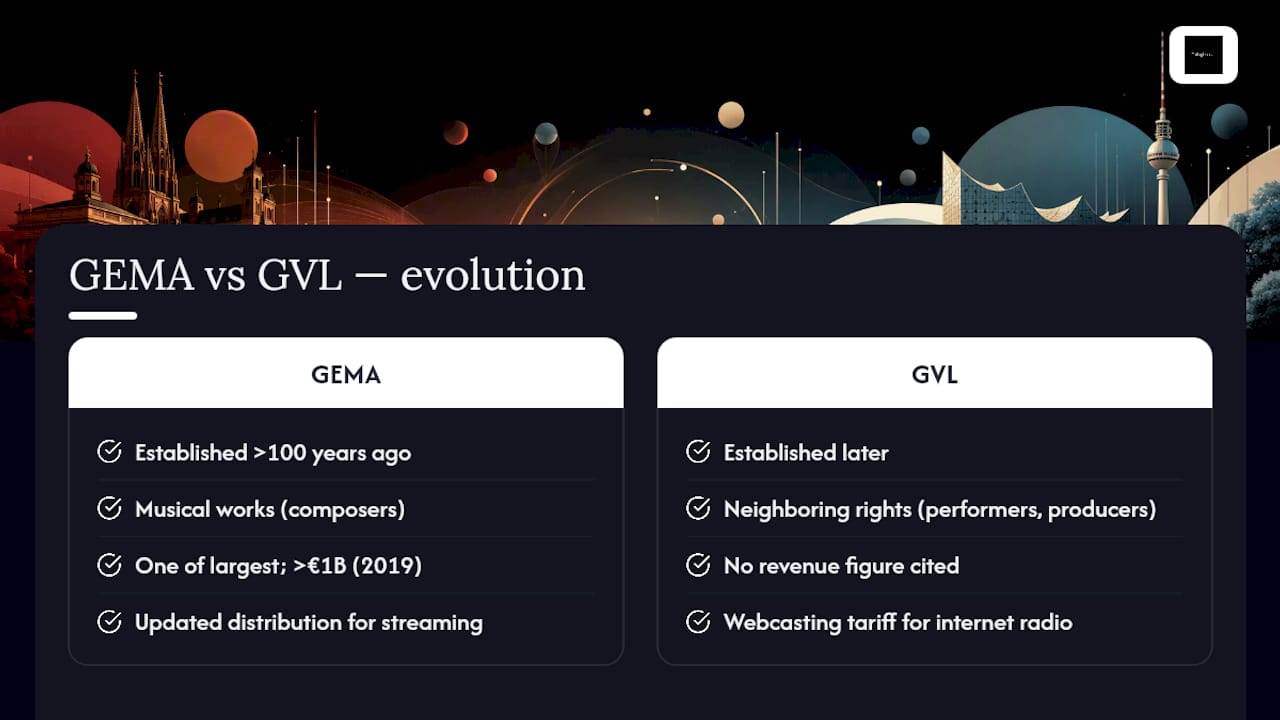
GEMA’s roots trace back over a century, evolving into its current legal structure as Germany’s central collecting society for musical works. It has grown into one of the largest organizations of its kind in the world, reportedly generating more than €1 billion in revenue in 2019 and distributing the substantial majority of that to its members. That scale reflects Germany’s position as one of Europe’s largest music markets, not an unusually aggressive collection model.

GVL emerged later as a distinct entity, formed specifically to address neighboring rights, the protections owed to performers and producers rather than composers. This split wasn’t arbitrary. It followed a broader European legal tradition that treats the creative act of writing a composition as separate from the technical and interpretive act of recording or performing it.

Both societies have adapted considerably as music distribution shifted from physical sales and terrestrial radio to streaming and web-based platforms. GVL’s webcasting tariff, for instance, exists because internet radio and streaming didn’t fit neatly into the licensing categories built for FM broadcasters decades earlier. GEMA has similarly updated its distribution plan repeatedly to account for how streaming revenue gets divided compared to older mechanical royalty models.

For independent hip-hop and beat-driven artists specifically, this evolution matters because most of your revenue streams, DSP royalties, sync placements, social media use, didn’t exist in the form both societies were originally built around. The infrastructure has caught up, but understanding how it developed explains some of the friction artists still encounter today.
Historical Background and Evolution of GEMA and GVL — overview diagram

International Reciprocity: Getting Paid for Plays Outside Germany

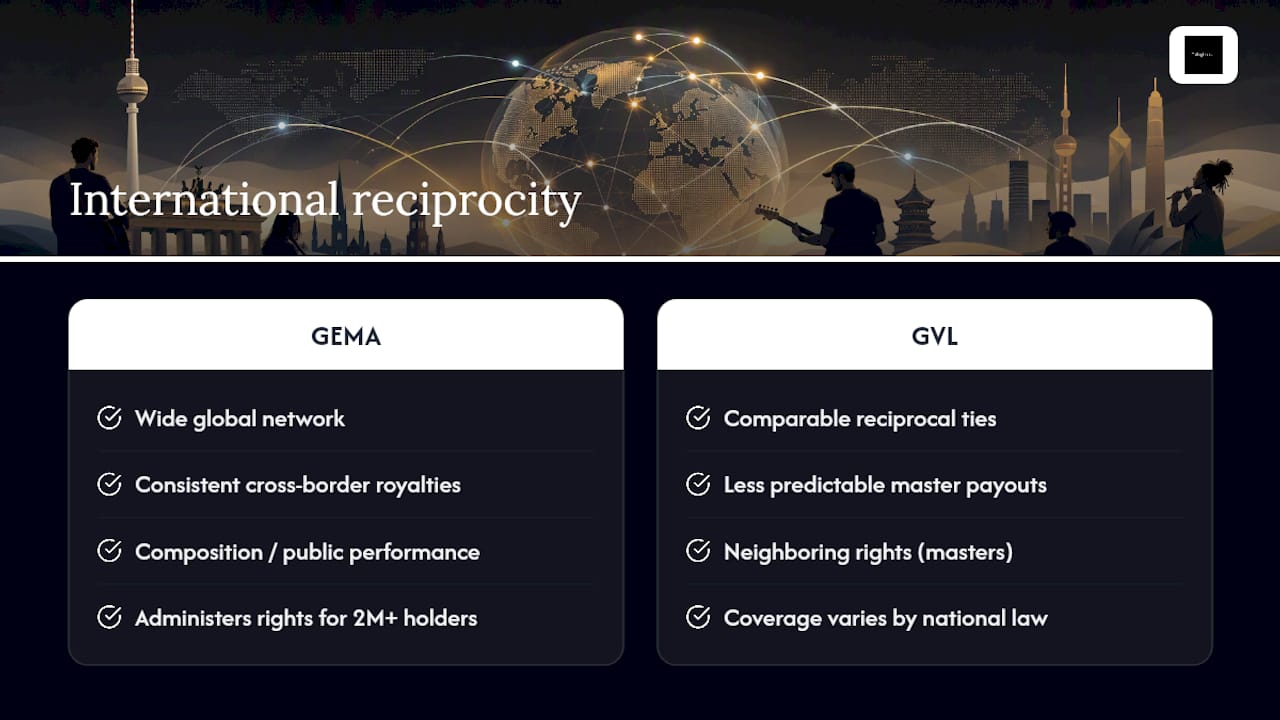
GEMA’s usefulness extends well beyond German borders because of reciprocal agreements with sister collecting societies worldwide. When your track gets played in France, the UK, or the United States, GEMA’s international partnerships mean the local society there can collect on your behalf and remit the money back through GEMA, rather than you needing separate memberships in every territory where your music gets used.

This reciprocal network is a major reason GEMA administers rights for over two million rightsholders globally, most of whom are members of foreign societies rather than GEMA itself. The same logic runs in reverse: foreign artists whose work gets played in Germany get paid through their home society’s agreement with GEMA.

GVL maintains comparable reciprocal relationships for neighboring rights, though the coverage and payout mechanics vary by country depending on how that country’s law treats performer and producer rights. Some countries recognize neighboring rights far more narrowly than Germany does, which means international payouts for masters can be less predictable than composition royalties.

For an independent artist weighing whether international registration is worth the effort, the practical takeaway is this: composition royalties through GEMA’s network tend to be more consistently collected across borders than master royalties through GVL’s, simply because more countries have mature performing-rights infrastructure than mature neighboring-rights infrastructure. That’s not a reason to skip GVL registration. It’s a reason to register early, since international pipelines take time to activate.
International Reciprocity: Getting Paid for Plays Outside Germany — overview diagram

A Creator’s Note: Why Sorting GEMA and GVL Early Matters

The hardest part of this system isn’t the paperwork. It’s accepting that you’re two different legal people at once: the writer and the performer. Artists who skip GVL registration because they registered with GEMA and assumed that covered everything often discover, months later, that an entire category of royalties never got collected. Nobody backfills that for you. Sort both registrations before your release date, not after the streams start counting.

— Thomas

How Tellingbeatzz Simplifies Licensing While You Handle Registration

Tellingbeatzz exists to remove one specific point of friction from this process: knowing exactly what you’re allowed to do with a beat and having the paperwork to prove it. With over 600 instrumentals available and the ability to build personalized beat packs, every license comes with unlimited commercial rights and the documentation to back them up.
Tellingbeatzz

That clarity matters more than it sounds like it should. When you sit down to register a composition with GEMA, you need to state definitively who the author and publisher are. A vague or informal beat arrangement makes that harder than it needs to be. A transparent license with clear metadata means you walk into that registration knowing exactly what you own and what you don’t, without guessing or chasing down a producer for confirmation weeks later.

If you’re building your next release, browse the catalog, secure a license that fits your commercial plans, and use the documentation Tellingbeatzz provides to move straight into your GEMA and GVL registration paperwork with the facts already settled.

Sources

No Comments

Leave a Reply

Choose A License

Mp3 Unlimited (+3 FREE)

MP3
License Terms

Unlimited License Agreement

This Unlimited License Agreement (the “Agreement”) is entered into on [Purchase Date] between Thomas Hodek, professionally known as Tellingbeatzz (“Licensor”) and [Customer Full Name] (“Licensee”).
The Licensee has purchased an MP3 Unlimited License for the instrumental titled “[Beat Title]” (“Beat”) for a license fee of [Purchase Price] under Order #[Order Number].
Upon successful payment, this Agreement becomes effective immediately and is delivered electronically together with the licensed Beat files.

1. Grant of License

The Licensor grants the Licensee a non-exclusive, worldwide, non-transferable and perpetual license to use the Beat to create and commercially exploit one or more new songs incorporating the Beat (“New Song”).
The Licensee may add vocals, lyrics, melodies, instrumentation, arrangements and other original contributions to the Beat.
The Beat itself remains the intellectual property of the Licensor and is not sold or transferred to the Licensee.

2. Unlimited Commercial Use

The Licensee may commercially release and use the New Song without limits on:
  • digital or physical distribution
  • sales
  • audio streams
  • monetized video streams
  • music videos
  • live or paid performances
  • radio and online broadcasts
  • social media content
  • albums, EPs, mixtapes and singles
There are no limits on streams, sales, downloads, views or performances generated by the New Song.

3. Master Recording and Revenue

The Licensee may create and commercially exploit a new master recording incorporating the Beat (“Master Recording”).
The Licensee retains the revenue generated directly from exploitation of the Master Recording, including streaming, digital distribution and physical sales, subject to any publishing, mechanical, performance or other composition-based royalties attributable to the Licensor’s share of the underlying composition.
The Licensor does not acquire ownership of the Licensee’s original lyrics, vocals or other independently created contributions.

4. Ownership

The Licensor retains all rights, title and interest in the original Beat, including the applicable copyright interests in the musical composition and sound recording.
This Agreement does not transfer ownership or copyright in the Beat to the Licensee.
The Licensee may protect or register their own original contributions to the New Song but may not claim sole ownership or authorship of the underlying Beat.

5. Publishing and Songwriting

For each New Song created under this Agreement, the underlying composition shall be divided as follows:
Licensee: 50%
Licensor: 50%
The Licensee agrees to properly identify the Licensor’s share when registering the New Song with a Performing Rights Organization, publisher, publishing administrator or other rights-management organization.
Licensor PRO Information:
Writer / Composer: Thomas Hodek
Producer Name: Tellingbeatzz
PRO: GEMA (Germany)
IPI / CAE: 716014087
Publishing Administrator: BeatStars Publishing Worldwide

6. Credit

Where credits are customarily provided, the Licensee agrees to credit the Producer as:
Produced by Tellingbeatzz
or
Beat by Tellingbeatzz
If additional featured-vocalist or hook credits are supplied with the Beat, those credits must also be included where reasonably applicable.

7. Content ID

Because the Beat may be licensed non-exclusively to multiple artists, the Licensee may not register the Beat or any New Song containing the Beat with YouTube Content ID or any similar automated copyright-claiming or fingerprinting system without prior written permission from the Licensor.
The Licensor reserves the right to register and administer the Beat through Content ID or similar systems.
If the Licensee receives a claim relating to a valid licensed use, proof of purchase may be submitted for review and release where appropriate.

8. Synchronization

The Licensee may synchronize the New Song with:
  • music videos
  • YouTube videos
  • social media content
  • podcasts
  • online promotional content
  • independent films and video projects
Major third-party commercial synchronization uses, including national advertising campaigns, television productions, feature films, major video games or comparable commercial projects, require prior written approval from the Licensor.

9. Prohibited Uses

The Licensee may not:
  1. resell, redistribute or sublicense the Beat in its original or substantially similar instrumental form;
  2. upload or distribute the Beat as a standalone instrumental under the Licensee’s name;
  3. include the Beat in beat packs, sample packs, loop libraries, sound libraries or production libraries;
  4. claim authorship or ownership of the original Beat;
  5. register the Beat or New Song with Content ID without permission;
  6. transfer this License to another person or entity without written consent;
  7. share the Beat files with third parties except persons directly involved in producing, recording, mixing, mastering or distributing the New Song.

10. Files Included

The files delivered depend on the license purchased:
MP3 Unlimited: MP3
WAV Unlimited: MP3 + WAV
Trackout Unlimited: MP3 + WAV + available tracked-out stems
The file format supplied does not change the commercial usage rights granted under this Agreement.

11. Non-Exclusive License

This is a non-exclusive license.
The Licensor may continue licensing or selling the same Beat to other customers.
The Licensee acknowledges that other artists may legally release different songs using the same Beat.

12. Future Exclusive Sale

If exclusive rights to the Beat are sold after this Agreement has taken effect, this License remains valid.
The Licensee may continue using, distributing and monetizing the New Song according to the terms of this Agreement.

13. Samples and Third-Party Material

Where the Beat contains third-party material requiring clearance, the Licensee is responsible for obtaining any additional clearance required for the Licensee’s intended use unless otherwise agreed in writing.
The Licensor will disclose known third-party clearance requirements where reasonably possible.

14. Term

This License is valid in perpetuity, provided the Licensee complies with this Agreement.
No renewal payment is required.

15. Breach

If the Licensee materially breaches this Agreement, the Licensor may provide written notice and, where the breach can reasonably be corrected, allow 30 days to cure the violation.
If the breach is not corrected within that period, the Licensor may terminate the License and pursue available remedies.

16. Governing Law

This Agreement is governed by the laws of the Federal Republic of Germany, without prejudice to mandatory consumer protection laws applicable to the Licensee.

17. Entire Agreement

This Agreement, together with the applicable WooCommerce order confirmation, constitutes the complete agreement between the Licensor and Licensee regarding the licensed Beat.
If any provision is found invalid or unenforceable, the remaining provisions remain effective.

WAV Unlimited (+6 FREE)

WAV, MP3
License Terms

Unlimited License Agreement

This Unlimited License Agreement (the “Agreement”) is entered into on [Purchase Date] between Thomas Hodek, professionally known as Tellingbeatzz (“Licensor”) and [Customer Full Name] (“Licensee”).
The Licensee has purchased an WAV Unlimited License for the instrumental titled “[Beat Title]” (“Beat”) for a license fee of [Purchase Price] under Order #[Order Number].
Upon successful payment, this Agreement becomes effective immediately and is delivered electronically together with the licensed Beat files.

1. Grant of License

The Licensor grants the Licensee a non-exclusive, worldwide, non-transferable and perpetual license to use the Beat to create and commercially exploit one or more new songs incorporating the Beat (“New Song”).
The Licensee may add vocals, lyrics, melodies, instrumentation, arrangements and other original contributions to the Beat.
The Beat itself remains the intellectual property of the Licensor and is not sold or transferred to the Licensee.

2. Unlimited Commercial Use

The Licensee may commercially release and use the New Song without limits on:
  • digital or physical distribution
  • sales
  • audio streams
  • monetized video streams
  • music videos
  • live or paid performances
  • radio and online broadcasts
  • social media content
  • albums, EPs, mixtapes and singles
There are no limits on streams, sales, downloads, views or performances generated by the New Song.

3. Master Recording and Revenue

The Licensee may create and commercially exploit a new master recording incorporating the Beat (“Master Recording”).
The Licensee retains the revenue generated directly from exploitation of the Master Recording, including streaming, digital distribution and physical sales, subject to any publishing, mechanical, performance or other composition-based royalties attributable to the Licensor’s share of the underlying composition.
The Licensor does not acquire ownership of the Licensee’s original lyrics, vocals or other independently created contributions.

4. Ownership

The Licensor retains all rights, title and interest in the original Beat, including the applicable copyright interests in the musical composition and sound recording.
This Agreement does not transfer ownership or copyright in the Beat to the Licensee.
The Licensee may protect or register their own original contributions to the New Song but may not claim sole ownership or authorship of the underlying Beat.

5. Publishing and Songwriting

For each New Song created under this Agreement, the underlying composition shall be divided as follows:
Licensee: 50%
Licensor: 50%
The Licensee agrees to properly identify the Licensor’s share when registering the New Song with a Performing Rights Organization, publisher, publishing administrator or other rights-management organization.
Licensor PRO Information:
Writer / Composer: Thomas Hodek
Producer Name: Tellingbeatzz
PRO: GEMA (Germany)
IPI / CAE: 716014087
Publishing Administrator: BeatStars Publishing Worldwide

6. Credit

Where credits are customarily provided, the Licensee agrees to credit the Producer as:
Produced by Tellingbeatzz
or
Beat by Tellingbeatzz
If additional featured-vocalist or hook credits are supplied with the Beat, those credits must also be included where reasonably applicable.

7. Content ID

Because the Beat may be licensed non-exclusively to multiple artists, the Licensee may not register the Beat or any New Song containing the Beat with YouTube Content ID or any similar automated copyright-claiming or fingerprinting system without prior written permission from the Licensor.
The Licensor reserves the right to register and administer the Beat through Content ID or similar systems.
If the Licensee receives a claim relating to a valid licensed use, proof of purchase may be submitted for review and release where appropriate.

8. Synchronization

The Licensee may synchronize the New Song with:
  • music videos
  • YouTube videos
  • social media content
  • podcasts
  • online promotional content
  • independent films and video projects
Major third-party commercial synchronization uses, including national advertising campaigns, television productions, feature films, major video games or comparable commercial projects, require prior written approval from the Licensor.

9. Prohibited Uses

The Licensee may not:
  1. resell, redistribute or sublicense the Beat in its original or substantially similar instrumental form;
  2. upload or distribute the Beat as a standalone instrumental under the Licensee’s name;
  3. include the Beat in beat packs, sample packs, loop libraries, sound libraries or production libraries;
  4. claim authorship or ownership of the original Beat;
  5. register the Beat or New Song with Content ID without permission;
  6. transfer this License to another person or entity without written consent;
  7. share the Beat files with third parties except persons directly involved in producing, recording, mixing, mastering or distributing the New Song.

10. Files Included

The files delivered depend on the license purchased:
MP3 Unlimited: MP3
WAV Unlimited: MP3 + WAV
Trackout Unlimited: MP3 + WAV + available tracked-out stems
The file format supplied does not change the commercial usage rights granted under this Agreement.

11. Non-Exclusive License

This is a non-exclusive license.
The Licensor may continue licensing or selling the same Beat to other customers.
The Licensee acknowledges that other artists may legally release different songs using the same Beat.

12. Future Exclusive Sale

If exclusive rights to the Beat are sold after this Agreement has taken effect, this License remains valid.
The Licensee may continue using, distributing and monetizing the New Song according to the terms of this Agreement.

13. Samples and Third-Party Material

Where the Beat contains third-party material requiring clearance, the Licensee is responsible for obtaining any additional clearance required for the Licensee’s intended use unless otherwise agreed in writing.
The Licensor will disclose known third-party clearance requirements where reasonably possible.

14. Term

This License is valid in perpetuity, provided the Licensee complies with this Agreement.
No renewal payment is required.

15. Breach

If the Licensee materially breaches this Agreement, the Licensor may provide written notice and, where the breach can reasonably be corrected, allow 30 days to cure the violation.
If the breach is not corrected within that period, the Licensor may terminate the License and pursue available remedies.

16. Governing Law

This Agreement is governed by the laws of the Federal Republic of Germany, without prejudice to mandatory consumer protection laws applicable to the Licensee.

17. Entire Agreement

This Agreement, together with the applicable WooCommerce order confirmation, constitutes the complete agreement between the Licensor and Licensee regarding the licensed Beat.
If any provision is found invalid or unenforceable, the remaining provisions remain effective.

Trackout Unlimited (+9 FREE)

WAV, MP3, Trackout
License Terms

Unlimited License Agreement

This Unlimited License Agreement (the “Agreement”) is entered into on [Purchase Date] between Thomas Hodek, professionally known as Tellingbeatzz (“Licensor”) and [Customer Full Name] (“Licensee”).
The Licensee has purchased an Trackout Unlimited License for the instrumental titled “[Beat Title]” (“Beat”) for a license fee of [Purchase Price] under Order #[Order Number].
Upon successful payment, this Agreement becomes effective immediately and is delivered electronically together with the licensed Beat files.

1. Grant of License

The Licensor grants the Licensee a non-exclusive, worldwide, non-transferable and perpetual license to use the Beat to create and commercially exploit one or more new songs incorporating the Beat (“New Song”).
The Licensee may add vocals, lyrics, melodies, instrumentation, arrangements and other original contributions to the Beat.
The Beat itself remains the intellectual property of the Licensor and is not sold or transferred to the Licensee.

2. Unlimited Commercial Use

The Licensee may commercially release and use the New Song without limits on:
  • digital or physical distribution
  • sales
  • audio streams
  • monetized video streams
  • music videos
  • live or paid performances
  • radio and online broadcasts
  • social media content
  • albums, EPs, mixtapes and singles
There are no limits on streams, sales, downloads, views or performances generated by the New Song.

3. Master Recording and Revenue

The Licensee may create and commercially exploit a new master recording incorporating the Beat (“Master Recording”).
The Licensee retains the revenue generated directly from exploitation of the Master Recording, including streaming, digital distribution and physical sales, subject to any publishing, mechanical, performance or other composition-based royalties attributable to the Licensor’s share of the underlying composition.
The Licensor does not acquire ownership of the Licensee’s original lyrics, vocals or other independently created contributions.

4. Ownership

The Licensor retains all rights, title and interest in the original Beat, including the applicable copyright interests in the musical composition and sound recording.
This Agreement does not transfer ownership or copyright in the Beat to the Licensee.
The Licensee may protect or register their own original contributions to the New Song but may not claim sole ownership or authorship of the underlying Beat.

5. Publishing and Songwriting

For each New Song created under this Agreement, the underlying composition shall be divided as follows:
Licensee: 50%
Licensor: 50%
The Licensee agrees to properly identify the Licensor’s share when registering the New Song with a Performing Rights Organization, publisher, publishing administrator or other rights-management organization.
Licensor PRO Information:
Writer / Composer: Thomas Hodek
Producer Name: Tellingbeatzz
PRO: GEMA (Germany)
IPI / CAE: 716014087
Publishing Administrator: BeatStars Publishing Worldwide

6. Credit

Where credits are customarily provided, the Licensee agrees to credit the Producer as:
Produced by Tellingbeatzz
or
Beat by Tellingbeatzz
If additional featured-vocalist or hook credits are supplied with the Beat, those credits must also be included where reasonably applicable.

7. Content ID

Because the Beat may be licensed non-exclusively to multiple artists, the Licensee may not register the Beat or any New Song containing the Beat with YouTube Content ID or any similar automated copyright-claiming or fingerprinting system without prior written permission from the Licensor.
The Licensor reserves the right to register and administer the Beat through Content ID or similar systems.
If the Licensee receives a claim relating to a valid licensed use, proof of purchase may be submitted for review and release where appropriate.

8. Synchronization

The Licensee may synchronize the New Song with:
  • music videos
  • YouTube videos
  • social media content
  • podcasts
  • online promotional content
  • independent films and video projects
Major third-party commercial synchronization uses, including national advertising campaigns, television productions, feature films, major video games or comparable commercial projects, require prior written approval from the Licensor.

9. Prohibited Uses

The Licensee may not:
  1. resell, redistribute or sublicense the Beat in its original or substantially similar instrumental form;
  2. upload or distribute the Beat as a standalone instrumental under the Licensee’s name;
  3. include the Beat in beat packs, sample packs, loop libraries, sound libraries or production libraries;
  4. claim authorship or ownership of the original Beat;
  5. register the Beat or New Song with Content ID without permission;
  6. transfer this License to another person or entity without written consent;
  7. share the Beat files with third parties except persons directly involved in producing, recording, mixing, mastering or distributing the New Song.

10. Files Included

The files delivered depend on the license purchased:
MP3 Unlimited: MP3
WAV Unlimited: MP3 + WAV
Trackout Unlimited: MP3 + WAV + available tracked-out stems
The file format supplied does not change the commercial usage rights granted under this Agreement.

11. Non-Exclusive License

This is a non-exclusive license.
The Licensor may continue licensing or selling the same Beat to other customers.
The Licensee acknowledges that other artists may legally release different songs using the same Beat.

12. Future Exclusive Sale

If exclusive rights to the Beat are sold after this Agreement has taken effect, this License remains valid.
The Licensee may continue using, distributing and monetizing the New Song according to the terms of this Agreement.

13. Samples and Third-Party Material

Where the Beat contains third-party material requiring clearance, the Licensee is responsible for obtaining any additional clearance required for the Licensee’s intended use unless otherwise agreed in writing.
The Licensor will disclose known third-party clearance requirements where reasonably possible.

14. Term

This License is valid in perpetuity, provided the Licensee complies with this Agreement.
No renewal payment is required.

15. Breach

If the Licensee materially breaches this Agreement, the Licensor may provide written notice and, where the breach can reasonably be corrected, allow 30 days to cure the violation.
If the breach is not corrected within that period, the Licensor may terminate the License and pursue available remedies.

16. Governing Law

This Agreement is governed by the laws of the Federal Republic of Germany, without prejudice to mandatory consumer protection laws applicable to the Licensee.

17. Entire Agreement

This Agreement, together with the applicable WooCommerce order confirmation, constitutes the complete agreement between the Licensor and Licensee regarding the licensed Beat.
If any provision is found invalid or unenforceable, the remaining provisions remain effective.

Download

To download your free version of please enter your name and email address and the download link will be emailed to you

Your download link has been emailed to you