


ISRC vs UPC for Independent Artists: What You Need
An ISRC identifies a single recording. A UPC identifies the release that recording lives on. Most independent artists need both: one ISRC for every track, one UPC for the release as a whole, and getting this pairing right protects how your streams get counted and your royalties get paid.
The practical consequence is bigger than it sounds. A mismatched or duplicated ISRC can split your streaming history across two identifiers, which quietly cuts your numbers on a platform’s chart algorithm and confuses collection societies trying to pay you. A wrong or missing UPC can get a release rejected by a distributor before it ever reaches a store.
Here’s what that means in practice:
- ISRC = International Standard Recording Code, one per track, permanent once assigned
- UPC = Universal Product Code, one per release, used for retail and chart reporting
- Both are governed by real standards bodies, ISRC — IFPI official site and ISO 3901, not by whichever distributor you happen to use
- Nearly every distributor assigns both codes automatically at no extra charge
Key Takeaways
Independent artists need one ISRC per track and one UPC per release, and both codes come free from a standard distributor.
| Point | Details |
|---|---|
| ISRC identifies the recording | A 12-character alphanumeric code assigned per track, permanent for identical audio. |
| UPC identifies the release | A 12-digit numeric code assigned per release, covers singles, EPs, and albums. |
| Reuse, don’t reassign, ISRCs | Keep the same ISRC across distributors and reissues to preserve streaming history. |
| Watch the field, not just the code | Letters signal an ISRC field; digits-only signals a UPC field, the fastest error check. |
| License your beats before you release | Tellingbeatzz provides unlimited commercial rights beats so your release metadata reflects clean, fully owned rights from the start. |
Table of Contents
- What Is an ISRC and Who Assigns It?
- What Is a UPC and Where Does It Come From?
- ISRC vs UPC: The Core Differences at a Glance
- How Do You Actually Get ISRCs and UPCs?
- Metadata Checklist Before You Hit Release
- Common Mistakes and How to Fix Them
- Frequently Asked Questions
- Sources
What Is an ISRC and Who Assigns It?
An ISRC (International Standard Recording Code) is a 12-character alphanumeric string that identifies one specific recording, and only that recording. It follows a fixed structure: a country/registrant prefix, a two-digit year-of-reference, and a five-digit designation code that must not repeat within the same calendar year for a given registrant. Think of it as a passport for your audio. It travels with that exact recording across every platform and release it ever appears on.
Most independent artists never deal with an ISRC agency directly. Your distributor acts as the registrant and assigns the code the moment you upload a track, and IFPI maintains the standard those distributors follow under ISO 3901. Streaming services, performance rights organizations, and broadcast monitors like SoundExchange and PPL all use the ISRC to route plays back to the correct recording and, from there, to the correct royalty payment.
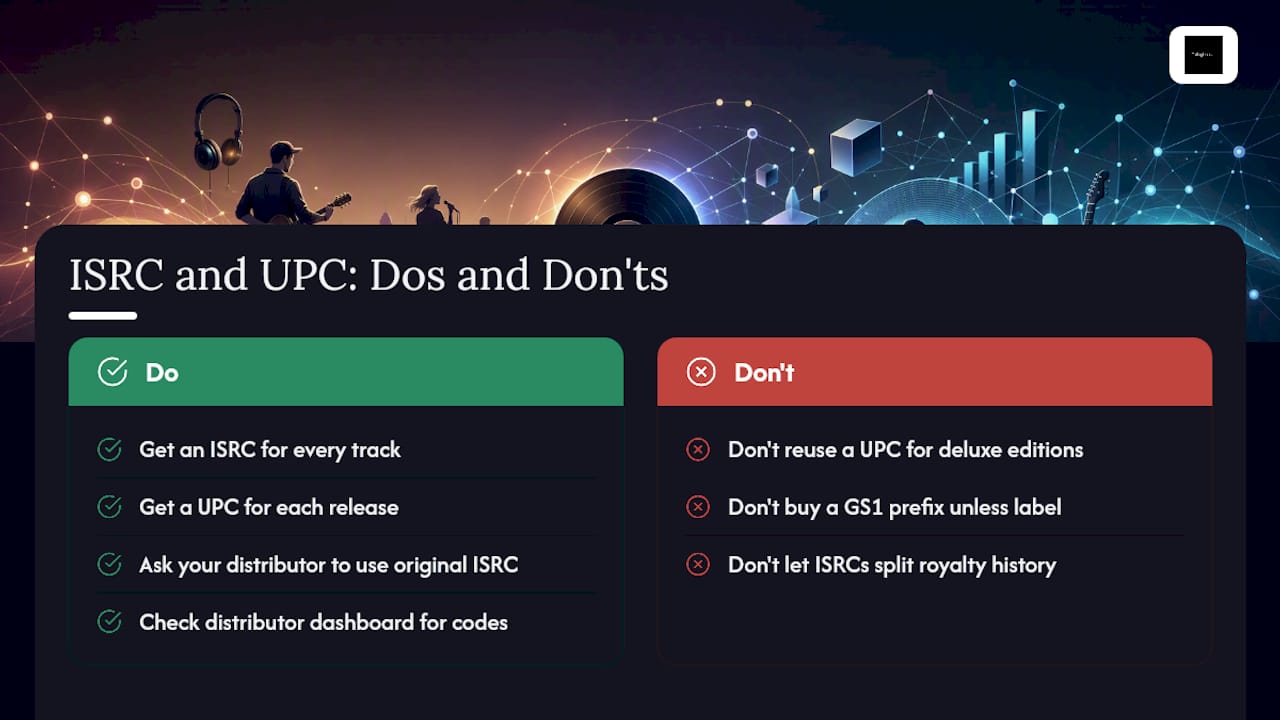
The permanence rule matters more than most artists realize. The same ISRC should be reused for identical audio if you re-release a track, move distributors, or reissue an EP. A remix, a remaster, or an edited radio version is a different recording, so it gets a new ISRC. Confuse those two situations and you fragment your own play count.
Pro Tip: Open your delivered audio file’s metadata before release and confirm the ISRC is actually embedded, not just listed in your distributor dashboard. A code that only exists on a spreadsheet somewhere does you no good once the file starts traveling.
What Is a UPC and Where Does It Come From?
A UPC (Universal Product Code) is a 12-digit numeric code that identifies the release itself, whether that’s a single, an EP, or a full album. In regions that use the 13-digit EAN-13 format instead, distributors handle that conversion transparently, so you rarely need to think about it.
UPCs are issued by GS1, the global organization that manages barcode numbering, though almost no independent artist registers with GS1 directly. Your distributor typically generates and assigns a UPC the moment you set up a release, the same way it handles ISRCs.
A few practical rules matter here:
- One release gets one UPC, no matter how many tracks it contains
- Digital stores, physical retail, and chart-tracking services all read the UPC to identify the product
- A deluxe edition, a re-release with bonus tracks, or a different version of an album needs its own new UPC
- Owning your own GS1 company prefix only makes sense for labels running large catalogs who need barcode continuity across many releases and distributors
For a one-off single or a standard album drop, letting your distributor assign the UPC is the simpler and equally valid path.
ISRC vs UPC: The Core Differences at a Glance
The fastest way to tell these codes apart on sight: an ISRC mixes letters and numbers and usually opens with two letters, while a UPC is digits only. That visual check catches most metadata mix-ups before they cause damage.
| What It Covers | ISRC | UPC |
|---|---|---|
| Identifies | The individual recording (track) | The release as a product (single, EP, album) |
| Format & example | 12-character alphanumeric, e.g. USRC1A23B4567 |
12-digit numeric, e.g. 123456789012 |
| How many needed | One per track, including edits and remixes | One per release, regardless of track count |
| Who issues it | Distributor, acting as ISRC registrant | Distributor, via a GS1-affiliated barcode |
| Where it’s used | Streaming platforms, royalty tracking, SoundExchange, PPL | Retail stores, digital shelves, chart reporting |
| Typical cost | Free through your distributor | Free through your distributor |
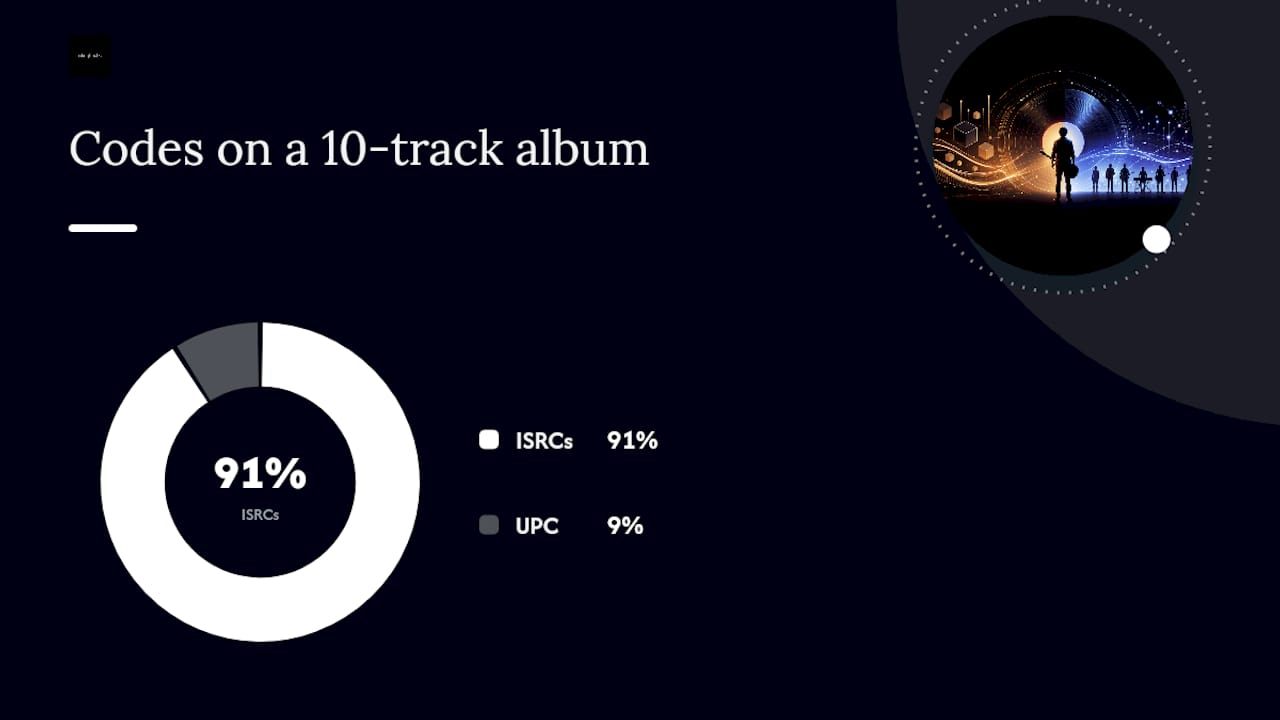
A 10-track album needs one UPC and 10 separate ISRCs, and if two of those tracks are alternate versions of the same song, that’s still two ISRCs, not one.
How Do You Actually Get ISRCs and UPCs?
- Prep your metadata before you upload anything. Nail down artist name spelling, featured contributors, composer splits, and an ISWC number for the composition if you have one.
- Upload through your distributor and let it assign both codes. Most distributor dashboards show the ISRC per track and the UPC for the release once processing finishes, and these codes come at no extra charge as part of standard distribution.
- Register your own codes only if you run a catalog. Getting a GS1 prefix or an ISRC registrant prefix makes sense for labels managing dozens of releases who need code continuity across distributors, not for a single artist dropping a few tracks a year.
- If you’re switching distributors, request your existing ISRCs first. Reusing the original code for the same audio keeps your streaming history and royalty trail intact instead of starting from zero.
Pro Tip: Unless you’re releasing under a label with a multi-year catalog strategy, staying with distributor-assigned codes is the lower-risk move. Managing your own prefixes means you also own the duplicate-checking and record-keeping that come with it.
Metadata Checklist Before You Hit Release
Run through this before submitting anything for distribution:
- ISRC present and correct for every individual track
- UPC present and correct for the release as a whole
- Artist and contributor names spelled consistently across every field
- Composer, publisher, and ISWC filled in where they apply, since linking ISRC to ISWC correctly is how songwriters actually collect mechanical royalties
- Release date and territory settings confirmed
- Audio files carry embedded metadata, not just dashboard entries
Keep a simple record, even a basic spreadsheet, of every ISRC and UPC you’ve been assigned and the delivery receipt for each release. Pro Tip: After release, cross-check your ISRCs against your distributor’s delivery report and any collection society portal you’re registered with. Catching a mismatch in week one is a five-minute fix; catching it a year later means chasing misattributed royalties.
Common Mistakes and How to Fix Them
- Typing a UPC into an ISRC field or vice versa, easy to miss since both run 12 characters
- Assigning a brand-new ISRC to audio that’s identical to a prior release, which splits your stream count in two
- Duplicate ISRC designation numbers issued in the same year
- Typos in a UPC that trigger an automatic distributor rejection
- Contact your distributor’s support team and request a metadata correction.
- Ask them to reuse the original ISRC rather than issue a new one for identical audio.
- Resubmit the corrected metadata package and confirm it processed.
- If royalties already went to the wrong identifier, notify your collection society directly. Missing or mismatched payments are worth escalating past a support ticket.
A Note From Tellingbeatzz
Working alongside independent artists on hundreds of releases has made one thing clear: clean metadata is what turns a stream into a paycheck. Getting your ISRC and UPC right the first time protects everything downstream.
Ready to Build Your Next Release?
Tellingbeatzz gives you unlimited commercial rights on every beat, which means the licensing side of your metadata checklist stays simple instead of tangled in exclusivity questions later.

Correct ISRC and UPC assignment only protects revenue that’s actually coming in, and that starts with a release built on a beat you fully own the rights to use. Tellingbeatzz offers over 600 instrumentals across hip-hop, rap, R&B, and soul, with the option to build a custom beat pack in MP3, WAV, or trackout formats and download instantly after checkout. There’s no ambiguity about what you’re allowed to release once you’ve licensed the beat, which makes the rest of your metadata prep, ISRCs, UPCs, contributor credits, straightforward instead of a guessing game. Browse the beat catalog and lock in a license before your next release goes to distribution.
Frequently Asked Questions
Do I need both an ISRC and a UPC for a single-track release?
Yes. Even a one-song release needs one ISRC for the track and one UPC for the release, since they identify different things and both feed into distribution and chart systems.
Can I reuse the same UPC for a deluxe edition of an album?
No. A deluxe edition with added tracks counts as a different release, so it needs its own UPC even though most of the audio is identical to the original.
What happens if my distributor assigns a new ISRC to a track I already released elsewhere?
Your stream counts and royalty history split across two identifiers instead of consolidating under one. Contact your distributor and request they use your original ISRC instead.
Is it worth getting my own GS1 barcode prefix as an independent artist?
Usually not. That step makes sense for labels managing large catalogs across multiple distributors, not for an artist releasing a handful of singles or albums a year.
Where can I find the ISRC and UPC once my release goes live?
Check your distributor’s dashboard under the release or track details, and cross-reference against your delivery report or any collection society portal you’re registered with.
No Comments