


Exclusive Rights Contract: What Creators Need to Sign
An exclusive rights contract gives one party the sole legal power to use or exploit an asset within a defined scope, which means the grantor cannot license those same rights to anyone else for the length of the term. Before you sign or ask someone else to, move fast on three things:
- Confirm the exact scope. Nail down the asset, field of use, territory, and duration in plain, measurable language.
- Require a written agreement. It must spell out remedies and assignment rules, because courts rarely infer exclusivity from a handshake or an email thread.
- Get counsel involved when the stakes are high. High dollar values or anything that smells like market foreclosure deserve a lawyer’s eyes before ink hits paper.
Below, you’ll find the clause-by-clause drafting checklist, what happens when someone breaks exclusivity, and sample language you can adapt today.
Key Takeaways
An exclusive rights contract holds up only when scope, duration, territory, and remedies are spelled out in writing and tied to measurable terms.
| Point | Details |
|---|---|
| Scope beats good intentions | Define the exact asset, field of use, territory, and duration before anything else is negotiated. |
| Written terms are non-optional | Courts rarely infer exclusivity from conduct, so the contract itself carries all enforcement weight. |
| Renewal should track performance | Link contract extensions to sales or promotional milestones, not just a calendar date. |
| Antitrust risk is real at scale | Exclusivity that forecloses market access can draw regulatory scrutiny under FTC guidance. |
| Tellingbeatzz simplifies exclusive beat buyouts | Custom beat packs come with clear, unlimited commercial rights and no hidden licensing terms. |
This article is general information, not a substitute for advice from a qualified lawyer. Consult a qualified legal professional about your own circumstances before acting on anything here.
Table of Contents
- What Is an Exclusive Rights Contract, Legally?
- Exclusive vs. Sole vs. Non-Exclusive: What’s the Real Difference?
- What Clauses Belong in an Exclusive Rights Contract?
- What Happens When Someone Breaks an Exclusive Rights Contract?
- What Should You Confirm Before You Sign?
- Sample Clauses You Can Adapt Right Now
- Sources
What Is an Exclusive Rights Contract, Legally?
An exclusive rights contract grants one party the sole right to use, reproduce, or exploit a specific asset, while the underlying ownership can still sit with the original creator. That distinction matters. Exclusivity is not the same as assignment, where ownership itself changes hands. A producer selling an exclusive beat license, a publisher signing an author to a single imprint, and a software company granting one distributor sole resale rights are all working the same legal mechanism with different assets attached.
Courts are reluctant to read exclusivity into casual conduct or a string of texts. The U.S. Copyright Office’s guidance on author agreements treats written terms as the backbone of any transfer or license, and UpCounsel’s overview of exclusive contracts makes the same point from the litigation side: a written agreement is what actually gets enforced.
Exclusive vs. Sole vs. Non-Exclusive: What’s the Real Difference?
Exclusive, sole, and non-exclusive licenses look similar on paper but carry different commercial weight. An exclusive license typically bars even the original owner from using the work unless the contract expressly carves out that right. A sole license still limits the field to one licensee, but the owner often keeps the right to use the asset personally. A non-exclusive license lets the owner sell the same rights to as many buyers as they want, which is why it’s priced far lower per unit.

The Legal Information Institute’s entry on exclusive licenses is blunt about this: the wording you choose changes what you can legally do afterward. In beat licensing, the contrast is easy to see. A non-exclusive beat license typically sells for a low price and can be distributed widely. An exclusive beat buyout removes the track from sale entirely and commands a premium because the buyer is paying for scarcity. A “sole” arrangement sits in between: rare in music, but occasionally used when a producer wants to retain personal or archival use.
What Clauses Belong in an Exclusive Rights Contract?
A solid exclusive rights contract works because every clause answers a specific “what if.” Skip one, and that’s exactly where a dispute takes root.
- Grant language: state precisely what rights transfer and under what conditions, not just “exclusive services.”
- Scope and field of use: define the asset and the specific use case it covers (commercial release, sync licensing, merchandising).
- Territory: worldwide, a single country, or a named region.
- Term and renewal: a fixed period, with clear conditions for extension.
- Compensation: flat fee, royalties, an exclusivity premium, or some combination.
- Performance obligations: minimum sales, release deadlines, or promotional commitments tied to renewal.
- Termination triggers: what breach looks like and how either side exits.
- Assignment and anti-assignment terms: whether either party can transfer the contract to a third party.
- Warranties and representations: confirmation that the grantor actually owns what they’re licensing.
- Indemnities: who covers legal costs if a third party claims infringement.
- Confidentiality: whether contract terms or unreleased material stay private.
- Dispute resolution and governing law: arbitration, mediation, or court, and under whose jurisdiction.
- Delivery and acceptance: file formats, deadlines, and what counts as a completed handoff.
- Record keeping and audit rights: the licensee’s ability to verify royalty statements or usage reports.
The clause that trips people up most is scope. Ironclad’s drafting guidance calls this the “four corners” of exclusivity: the asset, the field of use, the territory, and the duration. Nail all four down with numbers and named categories, not adjectives, and you’ve closed off most of the ways a dispute could start. Vague phrases like “exclusive services” or “all related content” are exactly what litigation feeds on.
Pre-existing material deserves its own line. If a producer’s signature sample or a writer’s stock phrase shows up inside the final deliverable, the contract should grant a perpetual, worldwide license for that specific element as used, according to Gouchev Law’s analysis of pre-existing IP. Otherwise you’re setting up a future infringement claim against your own client.
Pro Tip: Tie renewal terms to a performance benchmark, not just a calendar date. A licensee who hits zero of their promotional commitments shouldn’t automatically get another two years of exclusivity just because the clock ran out.
What Happens When Someone Breaks an Exclusive Rights Contract?
Breach of exclusivity typically opens the door to injunctions, monetary damages, an account of profits, or outright termination, depending on what the contract specifies. Liquidated damages clauses, which set a pre-agreed dollar figure for breach, make enforcement faster because nobody has to argue over what the loss was actually worth.
Before any of that, the practical steps matter: preserve every document and date tied to the unauthorized use, send a cease-and-desist letter, and loop in counsel before things escalate to a filing. UpCounsel’s research notes that written remedy clauses make disputes resolve faster, because the contract itself is doing most of the arguing.
There’s a separate risk that has nothing to do with breach: antitrust exposure. The FTC’s guidance on exclusive dealing warns that exclusivity arrangements can draw regulatory scrutiny when they substantially foreclose market access for competitors. That risk mostly applies at scale, not to a single producer selling one exclusive beat, but any business locking up an entire supply chain or distribution channel through exclusivity should weigh that guidance seriously.
What Should You Confirm Before You Sign?
Run through this sequence before either side signs anything:
- Identify the asset precisely. Name the exact file, master, manuscript, or module, not a general category.
- Lock down field of use and territory. Commercial release only, or does it cover sync, merchandising, and streaming too?
- Set duration and renewal terms. Fixed term with explicit renewal conditions beats an open-ended arrangement.
- Clarify payment and any exclusivity premium. Know whether it’s a flat buyout, ongoing royalties, or both.
- Attach performance milestones if relevant. Especially important for the grantor, who wants assurance the exclusivity is actually being used.
- Review assignment rules. Can either party transfer the contract to someone else without consent?
- Define termination triggers clearly. What specific behavior counts as breach.
- Carve out pre-existing IP. Confirm what the grantor owned before this deal and what stays theirs.
Three red flags should stop you cold: scope language that reads like marketing copy instead of a legal description, a territory or term with no real boundary, and an anti-assignment clause with zero reasonable exceptions. If you’re the grantor, protect the carve-outs and performance triggers. If you’re the grantee, protect the scope and the remedies.
Sample Clauses You Can Adapt Right Now
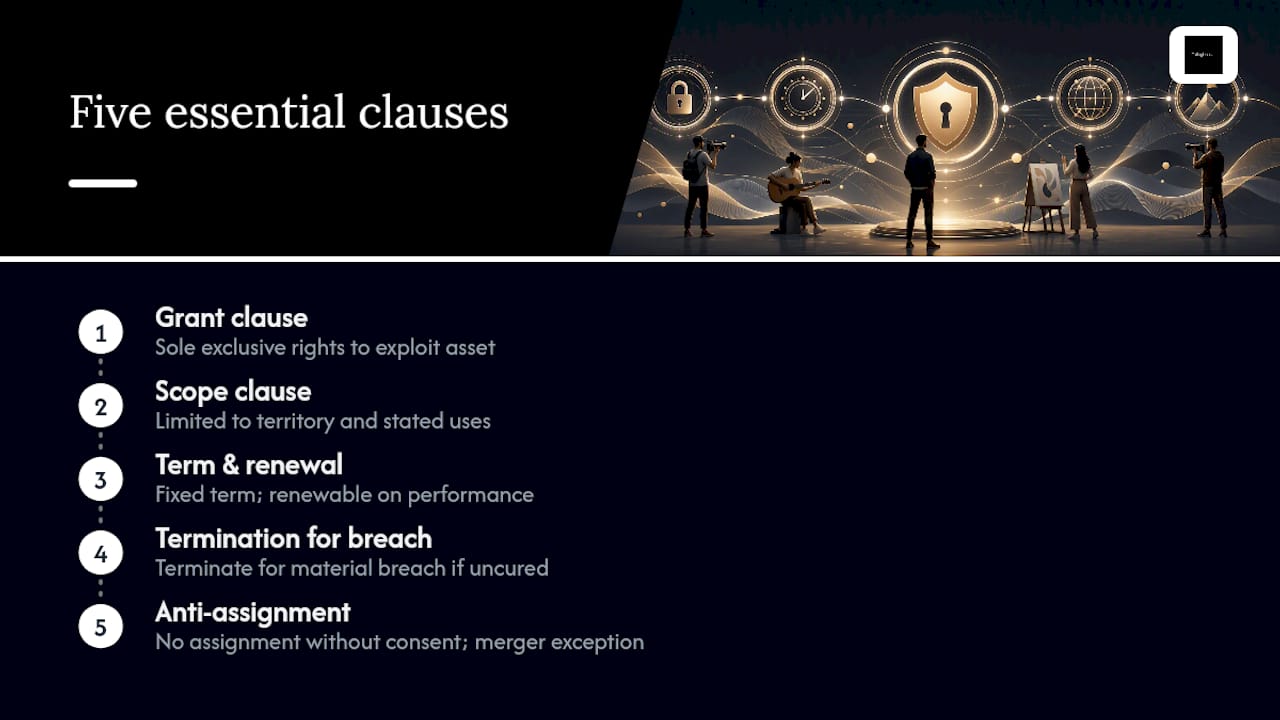
Here are five short building blocks. None of these replace a lawyer’s review, but they’ll get a first draft moving.
Grant clause: “Licensor grants Licensee the sole and exclusive right to reproduce, distribute, and commercially exploit [specific asset] within [defined field of use], for the Term specified below.”
Scope clause: “This grant is limited to [territory] and to use in [field of use, e.g., commercial audio release], excluding all other uses not expressly stated.”
Term and renewal clause: “This Agreement shall remain in effect for a fixed term, renewable upon performance condition unless either party provides written notice of non-renewal with sufficient advance notice prior to expiration.”
Termination-for-breach clause: “Either party may terminate this Agreement upon written notice if the other party materially breaches any term and fails to cure such breach within a reasonable period after notice.”
Anti-assignment clause: “Neither party may assign this Agreement without prior written consent, except in connection with a merger, acquisition, or sale of substantially all assets.”
Swap the bracketed terms depending on whether you’re licensing a beat, a manuscript, or a software module, and read the Copyright Alliance’s comparison of exclusive and non-exclusive licenses if you’re working in publishing specifically. None of this substitutes for a lawyer reviewing your actual deal.
Common Mistakes Creators Make With Exclusivity
Creators consistently undersell carve-outs for material they made before the deal. They also skip tying renewal to performance, which lets a passive buyer sit on exclusivity indefinitely. Before paying for a full legal review, archive every draft and timestamp your creation dates. That paper trail costs nothing and settles half of future disputes on sight.
How Tellingbeatzz Handles Exclusive Beat Licensing
Tellingbeatzz gives independent artists something most exclusive beat deals don’t: a one-time purchase with unlimited commercial rights and full transparency on what you’re actually buying, instead of a licensing structure buried in fine print. You can build a custom beat pack, choose MP3, WAV, or trackout formats, and lock in an exclusive buyout without negotiating scope clause by clause, since the terms are already clear before checkout.

That matters because the biggest risk in an exclusive rights contract for music is ambiguous scope, and Tellingbeatzz removes that ambiguity by structuring exclusivity into the license itself rather than leaving it to a back-and-forth negotiation. If you need a custom exclusive pack or want to see how the licensing terms are structured before you commit, browse available beats and licensing options and reach out for a custom quote.
Sources
- Federal Trade Commission — Exclusive dealing or requirements contracts
- Legal Information Institute — Exclusive license
- U.S. Copyright Office circular 12 (Author agreements)
- UpCounsel — An exclusive contract
- Ironclad — How to draft exclusivity clauses
No Comments