

Interpolation vs Sampling: What Every Producer Must Know
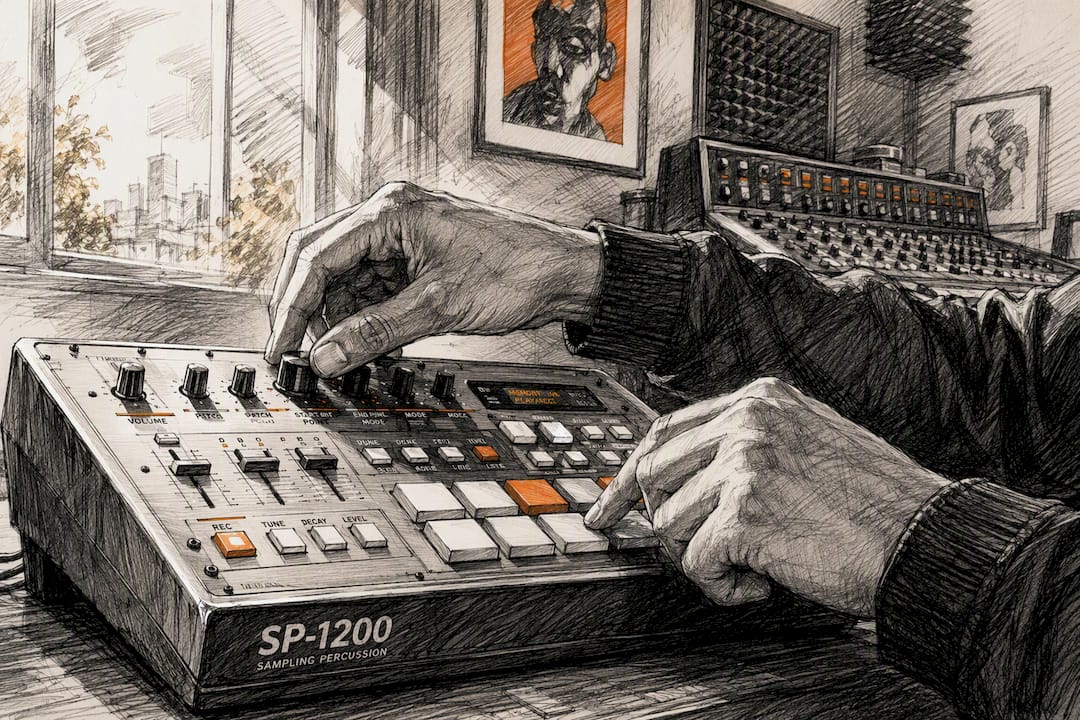
Producer hands adjusting hardware sampler

Interpolation vs Sampling: What Every Producer Must Know

Sampling reuses the actual sound recording, which means you need permission from both the composition owner and the master owner. Interpolation re-records the melody, lyric, or musical phrase from scratch, which means you only need the composition owner’s blessing. That single distinction determines everything about cost, timeline, and creative flexibility for the rest of your project.

The practical fallout looks like this:

  • Sampling requires two separate negotiations, one for the song itself and one for the specific recording, and both can say no independently.
  • Interpolation skips the master-use license entirely, but the publisher still expects credit and a royalty share once you touch their composition.
  • Neither route is free of paperwork. Interpolation just trims the guest list you need permission from.

TL;DR:

  • Sampling requires licenses from both the sound recording owner and the composition owner, making it more complex and costly than interpolation.
  • Interpolation only needs clearance from the publisher of the composition, simplifying negotiations but still requiring royalties and credit.
  • Clearing a sample involves negotiating both the master and composition rights, which can add weeks or months to release timelines.
  • Using pre-cleared instrumentals like those from Tellingbeatzz eliminates licensing hurdles and allows faster, dispute-free releases.
  • Authenticity risks differ: sampling captures exact original sounds, while interpolation offers greater control but may miss the original’s character.

Table of Contents

Sampling keeps the original texture intact. A drum break, a vocal ad lib, or a horn stab carries the exact air and imperfection of the room it was recorded in, and no amount of modern plugin trickery fully replicates that. Interpolation trades that authenticity for control. You can shift the key, slow the tempo, swap the instrumentation, or hand the part to a live player who plays it your way instead of the original way.

The rights split explains why the two paths feel so different in practice. A song has two separate copyrights: the composition (melody, lyrics, chord structure) and the sound recording, or “master” (the specific captured performance). Sampling touches both, so you owe two sets of gatekeepers. Interpolation only touches the composition, so the master owner, often a label, never enters the conversation.

That gap shows up directly in negotiation complexity:

  1. Sampling means separate deals with a publisher and a label, often at different speeds and different price points.
  2. Interpolation means one deal with the publisher, though that deal still involves a writing credit and a publishing percentage.
  3. Cost tends to run higher for sampling because you are paying two parties instead of one, and a label can attach a steep upfront master-use fee on top of royalties.
  4. Timing favors interpolation in most cases, since one negotiation thread moves faster than two.

Sampling remains the only real option when the sound itself is the point. A specific vocal performance, a rare drum machine’s exact decay, or a horn section’s particular grit can’t be re-created by a session musician no matter how skilled they are.

Pro Tip: Before you commit to re-recording a part, isolate what you actually need. If it’s the melody or lyric, interpolation works fine. If it’s the grain of a specific performance, you’re looking at a sample, not a substitute.

Clearing an Interpolation or a Sample: The Actual Steps

Clearance is not a single phone call. It’s a short chain of specific people who each hold a piece of the puzzle, and skipping one step tends to cost you later, usually right when you’re ready to release.

Start by identifying who owns what:

  1. Search a performing rights organization database (ASCAP, BMI, SESAC) to find the publisher and songwriter splits on the composition.
  2. Check distributor or label metadata, or contact the label directly, to identify the master owner if you’re sampling.
  3. Confirm both parties are still the correct rights holders. Catalogs get sold, and old contact information goes stale fast.

Once you know who to contact, the request differs by method:

  • For an interpolation, request a composition license (sometimes called a mechanical or synchronization license depending on use) directly from the publisher.
  • For a sample, request both a composition license from the publisher and a master-use license from the label or master owner.

Negotiated outcomes vary, but a few patterns repeat often enough to plan around. Publishers frequently ask for a songwriting credit alongside a percentage of the publishing split rather than a flat fee. Labels sampling a master more commonly ask for an upfront payment plus a royalty percentage. Each side negotiates separately, and one saying yes doesn’t guarantee the other will.

Start this process before you lock a release date, not after. Clearance can take anywhere from a few weeks for a cooperative publisher to several months when a label’s legal department gets involved, and distributors will hold your release if clearance isn’t documented.

Famous Interpolations and Samples, and How They Were Cleared

Real examples make the distinction easier to hold onto than any definition.

  • Coolio’s “Gangsta’s Paradise” interpolates Stevie Wonder’s “Pastime Paradise.” The composition was re-recorded, so only publishing clearance was required, though Wonder reportedly requested lyrical changes as a condition of approval.
  • Countless drill and trap records interpolate 1990s R&B hooks, swapping the original vocal for a new take while keeping the melody, a common budget move when the master owner is difficult to reach.
  • Classic sample-based hip-hop, built on looped soul and funk breaks, required both composition and master clearance from the outset, which is why so many golden-era records carry dense sample-credit lists in their liner notes.
  • Disputes tend to surface when an artist skips clearance altogether and releases first, hoping no one notices. That gamble routinely ends in a retroactive settlement that costs more than a negotiated license would have upfront.

A Quick Checklist Before You Interpolate or Sample

Run through this before you commit studio time to either approach:

  • Texture check: Can a re-recorded version capture what you need, or is the original performance the actual hook?
  • Budget check: Two licenses (sampling) generally cost more than one (interpolation).
  • Timeline check: How close is your release date, and can it absorb a slow-moving negotiation?
  • Access check: Do you have a player who can actually nail the part, or will a re-record sound like a cheap imitation?

Document everything as you go. Timestamp your session file, save your stems separately, and jot down who played or programmed each part. Publishers routinely ask for this evidence before they’ll finalize a license, and having it ready cuts weeks off the back-and-forth. Register your splits accurately with your PRO the moment terms are settled. A publishing credit that never gets registered is a royalty check that never arrives.

Pro Tip: Keep a simple spreadsheet across your catalog listing every interpolated or sampled element, who you contacted, and what was agreed. It turns a scattered memory problem into a five-minute lookup when a distributor asks for proof.

What Years of Clearance Headaches Taught Us

Every producer who has chased a publisher for six weeks over a four-bar interpolation understands why so many artists eventually look for a way around the whole process. Clearance work rewards patience and paperwork discipline, not talent, which is a frustrating trade when you’d rather be writing the next song.

Tellingbeatzz built its catalog around a simpler premise: independent artists shouldn’t need a publishing contact list before they can release music. Every instrumental in the catalog, over 600 and growing, comes with commercial rights baked into the license, no interpolation request and no master-use negotiation required.

A pre-licensed beat means you’re not waiting on a publisher’s email reply to hit your release date. The clearance work is already done before you ever hit play.

Artists building on Tellingbeatzz instrumentals have generated over 200 million streams without a single one of those streams triggering a sample dispute, which says something about how much friction a pre-cleared catalog actually removes.

How Interpolation and Sampling Work Differently in the Studio

Sampling starts with a digital audio file, an existing recording chopped, pitched, time stretched, or looped inside a digital audio workstation. The producer manipulates a waveform that already exists, preserving the microphone bleed, tape saturation, or room tone baked into the original take. Worth separating here: audio engineers also use the word “sampling” to describe converting analog sound into digital data points, a signal-processing concept covered in detail on Wikipedia’s sampling entry. That’s a different use of the term from musical sampling, and conflating the two causes real confusion in production forums.

Interpolation starts from a blank session. A musician, often the original producer or a hired session player, listens to the reference and re-plays or re-sings the part using new instruments, a new vocalist, or a new arrangement entirely. Nothing from the original audio file makes it into the final master. The melody and rhythm might match closely, sometimes note for note, but the captured sound is entirely new.

This changes what you’re actually manipulating during production. Sampling work happens in an audio editor, chopping transients and adjusting pitch without touching the underlying performance. Interpolation work happens in a recording booth or a MIDI sequencer, building a new performance around an old idea. One preserves a moment in time. The other borrows a shape and fills it with new material, which is why interpolated tracks often carry a noticeably different feel even when the melody is unmistakable.
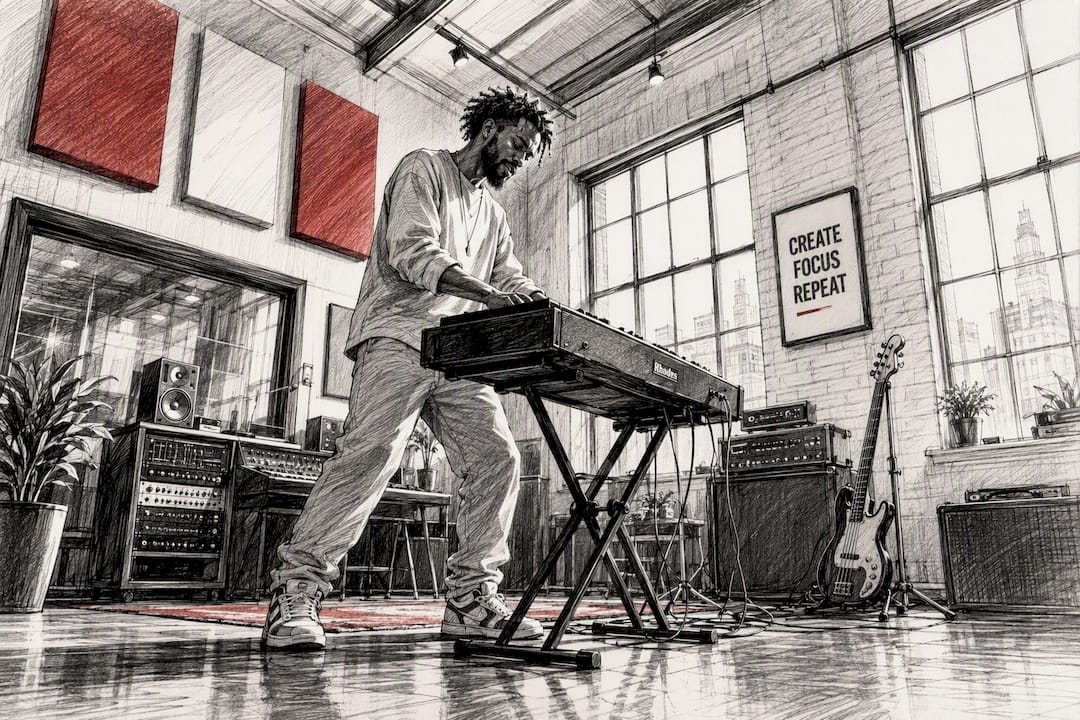
Musician playing keyboard in studio

When Interpolation and Sampling End Up in Court

Legal disputes over unauthorized sampling stretch back decades, and the pattern rarely changes: an artist releases a track built on someone else’s recording without a master-use license, and the master owner sues after the fact. Because sampling implicates two separate copyrights, a producer can clear the composition and still get sued by the label that owns the master, or the reverse.

Interpolation disputes look different. Since no original recording gets used, litigation tends to center on whether the re-recorded melody or lyric crosses from inspired-by into infringing territory, and whether proper composition clearance was secured beforehand. Coolio’s public objection to how “Gangsta’s Paradise” handled his interpolation of “Pastime Paradise” illustrates the softer end of this risk: a cleared composition can still generate public friction if the songwriter feels the tone or message was misrepresented.

The safest legal position in either case is documented, upfront permission. The U.S. Copyright Office frames composition rights and recording rights as separate legal instruments precisely because courts treat them separately. A license for one never implies permission for the other, and assuming otherwise is how avoidable lawsuits happen.

Sound Quality and Artistic Expression: The Real Tradeoff

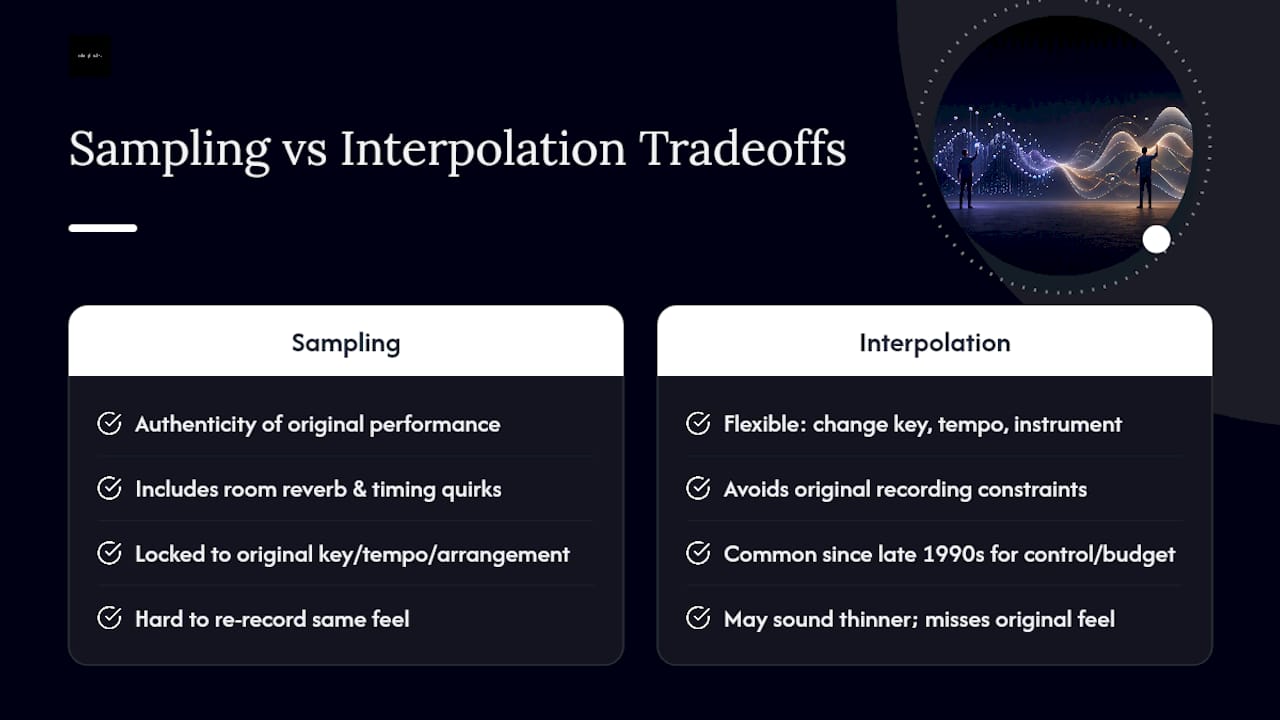
Sampling gives you a piece of history you can’t fake. A specific drummer’s timing quirks, a specific room’s natural reverb, a vocalist’s exact rasp on a given take: these carry an authenticity that re-recording struggles to match, no matter how good the session player is. That’s the appeal, and it’s also the constraint. You’re locked into the original key, tempo, and arrangement unless you’re willing to accept audible pitch or time artifacts from stretching the audio too far.

Interpolation trades that authenticity for freedom. A songwriter can raise the key to fit a new vocalist’s range, slow the tempo for a different mood, or swap a piano line for a guitar without asking anyone’s permission on the recording side. That flexibility is exactly why interpolation became a common budget and control-driven alternative starting in the late 1990s, when producers wanted the reference without the rigid constraints of someone else’s finished take.

The honest tradeoff is that re-created parts can miss the original’s feel even when every note matches. A session musician replicating a bassline note for note still won’t reproduce the specific fingers, the specific amp, or the specific mood of the day it was first recorded. Producers who choose interpolation purely to save money sometimes discover the re-record sounds thinner than the reference, and no amount of mixing rescues a performance that never had the original’s character to begin with.
Sound Quality and Artistic Expression: The Real Tradeoff — overview diagram

Building Interpolations and Samples: The Practical Toolkit

Sampling work leans on tools built for slicing and reshaping existing audio. A digital audio workstation with a capable sampler instrument, whether a stock plugin or a dedicated sampling engine, lets a producer chop a break into pads, stretch it to a new tempo, or pitch it to a new key. Crate-digging, whether through vinyl or digital sample libraries, remains the first step long before any editing happens.

Interpolation work leans on the opposite skill set: musicianship and arrangement. A producer needs either the ability to play the borrowed part themselves or access to a session musician who can. MIDI programming often substitutes for a live player when the part is simple enough, letting a producer approximate a melody without booking studio time. Vocal interpolations typically involve a new singer learning the phrasing by ear and adapting it to a fresh arrangement, sometimes with only the general shape of the original melody surviving the process.

Session organization matters regardless of which path you take. Keeping stems, take notes, and timestamps organized inside your project file isn’t just good practice, it’s what makes clearance conversations faster once a publisher or label asks for specifics.

The Part Nobody Wants to Talk About

Interpolation quietly sidesteps a real ethical question: the session musicians and performers who made the original recording iconic often get nothing when their exact performance isn’t used, even though the underlying song keeps generating money for its writers.

If the original recording’s character is genuinely irreplaceable, paying for the sample is often the more honest move. If a session player can capture the same spirit, interpolation saves money without erasing anyone’s due. Either way, register your credits and splits accurately. Transparency there protects you and everyone whose work made the song possible.

— Thomas

A Clearance-Free Alternative Worth Considering

There’s real value in learning to clear a sample or negotiate a composition license. But if your goal is simply to release music without chasing publishers for weeks, Tellingbeatzz offers a genuinely different starting point.
Tellingbeatzz

Every instrumental in the Tellingbeatzz catalog ships with unlimited commercial rights already attached. No sample to trace, no interpolation to license, no publisher email chain standing between your session file and a release date. Choose from MP3, WAV, or full trackout formats, or build a custom beat pack across hundreds of hip-hop, rap, R&B, and soulful instrumentals tailored to your project. The licensing terms are stated upfront, plainly, with no fine print designed to trip you up later.

Buying a pre-licensed beat doesn’t replace understanding interpolation and sampling, it removes the need to navigate that process at all for the instrumental itself. You still own what you build on top of it. If your next release is closer to done than your clearance paperwork is, browse the Tellingbeatzz catalog and see what fits the song you’re already working on.

Key Takeaways

Interpolation clears faster and costs less because it involves only the composition, while sampling requires both composition and master permission before release.

Point Details
Two rights, two owners Sampling needs a composition license and a master-use license; interpolation needs only the composition license.
Interpolation still costs something Publishers typically require a songwriting credit and a share of the publishing royalties, even without a master fee.
Start clearance early Composition and master negotiations can take weeks to months, so begin before setting a release date.
Document your session Save timestamps, stems, and performance notes to speed up publisher requests for proof.
Consider a pre-cleared route Tellingbeatzz sells hip-hop instrumentals with unlimited commercial rights already included, removing sample and interpolation clearance from the release process entirely.

Sources

No Comments

Leave a Reply

Choose A License

Mp3 Unlimited (+3 FREE)

MP3
License Terms

Unlimited License Agreement

This Unlimited License Agreement (the “Agreement”) is entered into on [Purchase Date] between Thomas Hodek, professionally known as Tellingbeatzz (“Licensor”) and [Customer Full Name] (“Licensee”).
The Licensee has purchased an MP3 Unlimited License for the instrumental titled “[Beat Title]” (“Beat”) for a license fee of [Purchase Price] under Order #[Order Number].
Upon successful payment, this Agreement becomes effective immediately and is delivered electronically together with the licensed Beat files.

1. Grant of License

The Licensor grants the Licensee a non-exclusive, worldwide, non-transferable and perpetual license to use the Beat to create and commercially exploit one or more new songs incorporating the Beat (“New Song”).
The Licensee may add vocals, lyrics, melodies, instrumentation, arrangements and other original contributions to the Beat.
The Beat itself remains the intellectual property of the Licensor and is not sold or transferred to the Licensee.

2. Unlimited Commercial Use

The Licensee may commercially release and use the New Song without limits on:
  • digital or physical distribution
  • sales
  • audio streams
  • monetized video streams
  • music videos
  • live or paid performances
  • radio and online broadcasts
  • social media content
  • albums, EPs, mixtapes and singles
There are no limits on streams, sales, downloads, views or performances generated by the New Song.

3. Master Recording and Revenue

The Licensee may create and commercially exploit a new master recording incorporating the Beat (“Master Recording”).
The Licensee retains the revenue generated directly from exploitation of the Master Recording, including streaming, digital distribution and physical sales, subject to any publishing, mechanical, performance or other composition-based royalties attributable to the Licensor’s share of the underlying composition.
The Licensor does not acquire ownership of the Licensee’s original lyrics, vocals or other independently created contributions.

4. Ownership

The Licensor retains all rights, title and interest in the original Beat, including the applicable copyright interests in the musical composition and sound recording.
This Agreement does not transfer ownership or copyright in the Beat to the Licensee.
The Licensee may protect or register their own original contributions to the New Song but may not claim sole ownership or authorship of the underlying Beat.

5. Publishing and Songwriting

For each New Song created under this Agreement, the underlying composition shall be divided as follows:
Licensee: 50%
Licensor: 50%
The Licensee agrees to properly identify the Licensor’s share when registering the New Song with a Performing Rights Organization, publisher, publishing administrator or other rights-management organization.
Licensor PRO Information:
Writer / Composer: Thomas Hodek
Producer Name: Tellingbeatzz
PRO: GEMA (Germany)
IPI / CAE: 716014087
Publishing Administrator: BeatStars Publishing Worldwide

6. Credit

Where credits are customarily provided, the Licensee agrees to credit the Producer as:
Produced by Tellingbeatzz
or
Beat by Tellingbeatzz
If additional featured-vocalist or hook credits are supplied with the Beat, those credits must also be included where reasonably applicable.

7. Content ID

Because the Beat may be licensed non-exclusively to multiple artists, the Licensee may not register the Beat or any New Song containing the Beat with YouTube Content ID or any similar automated copyright-claiming or fingerprinting system without prior written permission from the Licensor.
The Licensor reserves the right to register and administer the Beat through Content ID or similar systems.
If the Licensee receives a claim relating to a valid licensed use, proof of purchase may be submitted for review and release where appropriate.

8. Synchronization

The Licensee may synchronize the New Song with:
  • music videos
  • YouTube videos
  • social media content
  • podcasts
  • online promotional content
  • independent films and video projects
Major third-party commercial synchronization uses, including national advertising campaigns, television productions, feature films, major video games or comparable commercial projects, require prior written approval from the Licensor.

9. Prohibited Uses

The Licensee may not:
  1. resell, redistribute or sublicense the Beat in its original or substantially similar instrumental form;
  2. upload or distribute the Beat as a standalone instrumental under the Licensee’s name;
  3. include the Beat in beat packs, sample packs, loop libraries, sound libraries or production libraries;
  4. claim authorship or ownership of the original Beat;
  5. register the Beat or New Song with Content ID without permission;
  6. transfer this License to another person or entity without written consent;
  7. share the Beat files with third parties except persons directly involved in producing, recording, mixing, mastering or distributing the New Song.

10. Files Included

The files delivered depend on the license purchased:
MP3 Unlimited: MP3
WAV Unlimited: MP3 + WAV
Trackout Unlimited: MP3 + WAV + available tracked-out stems
The file format supplied does not change the commercial usage rights granted under this Agreement.

11. Non-Exclusive License

This is a non-exclusive license.
The Licensor may continue licensing or selling the same Beat to other customers.
The Licensee acknowledges that other artists may legally release different songs using the same Beat.

12. Future Exclusive Sale

If exclusive rights to the Beat are sold after this Agreement has taken effect, this License remains valid.
The Licensee may continue using, distributing and monetizing the New Song according to the terms of this Agreement.

13. Samples and Third-Party Material

Where the Beat contains third-party material requiring clearance, the Licensee is responsible for obtaining any additional clearance required for the Licensee’s intended use unless otherwise agreed in writing.
The Licensor will disclose known third-party clearance requirements where reasonably possible.

14. Term

This License is valid in perpetuity, provided the Licensee complies with this Agreement.
No renewal payment is required.

15. Breach

If the Licensee materially breaches this Agreement, the Licensor may provide written notice and, where the breach can reasonably be corrected, allow 30 days to cure the violation.
If the breach is not corrected within that period, the Licensor may terminate the License and pursue available remedies.

16. Governing Law

This Agreement is governed by the laws of the Federal Republic of Germany, without prejudice to mandatory consumer protection laws applicable to the Licensee.

17. Entire Agreement

This Agreement, together with the applicable WooCommerce order confirmation, constitutes the complete agreement between the Licensor and Licensee regarding the licensed Beat.
If any provision is found invalid or unenforceable, the remaining provisions remain effective.

WAV Unlimited (+6 FREE)

WAV, MP3
License Terms

Unlimited License Agreement

This Unlimited License Agreement (the “Agreement”) is entered into on [Purchase Date] between Thomas Hodek, professionally known as Tellingbeatzz (“Licensor”) and [Customer Full Name] (“Licensee”).
The Licensee has purchased an WAV Unlimited License for the instrumental titled “[Beat Title]” (“Beat”) for a license fee of [Purchase Price] under Order #[Order Number].
Upon successful payment, this Agreement becomes effective immediately and is delivered electronically together with the licensed Beat files.

1. Grant of License

The Licensor grants the Licensee a non-exclusive, worldwide, non-transferable and perpetual license to use the Beat to create and commercially exploit one or more new songs incorporating the Beat (“New Song”).
The Licensee may add vocals, lyrics, melodies, instrumentation, arrangements and other original contributions to the Beat.
The Beat itself remains the intellectual property of the Licensor and is not sold or transferred to the Licensee.

2. Unlimited Commercial Use

The Licensee may commercially release and use the New Song without limits on:
  • digital or physical distribution
  • sales
  • audio streams
  • monetized video streams
  • music videos
  • live or paid performances
  • radio and online broadcasts
  • social media content
  • albums, EPs, mixtapes and singles
There are no limits on streams, sales, downloads, views or performances generated by the New Song.

3. Master Recording and Revenue

The Licensee may create and commercially exploit a new master recording incorporating the Beat (“Master Recording”).
The Licensee retains the revenue generated directly from exploitation of the Master Recording, including streaming, digital distribution and physical sales, subject to any publishing, mechanical, performance or other composition-based royalties attributable to the Licensor’s share of the underlying composition.
The Licensor does not acquire ownership of the Licensee’s original lyrics, vocals or other independently created contributions.

4. Ownership

The Licensor retains all rights, title and interest in the original Beat, including the applicable copyright interests in the musical composition and sound recording.
This Agreement does not transfer ownership or copyright in the Beat to the Licensee.
The Licensee may protect or register their own original contributions to the New Song but may not claim sole ownership or authorship of the underlying Beat.

5. Publishing and Songwriting

For each New Song created under this Agreement, the underlying composition shall be divided as follows:
Licensee: 50%
Licensor: 50%
The Licensee agrees to properly identify the Licensor’s share when registering the New Song with a Performing Rights Organization, publisher, publishing administrator or other rights-management organization.
Licensor PRO Information:
Writer / Composer: Thomas Hodek
Producer Name: Tellingbeatzz
PRO: GEMA (Germany)
IPI / CAE: 716014087
Publishing Administrator: BeatStars Publishing Worldwide

6. Credit

Where credits are customarily provided, the Licensee agrees to credit the Producer as:
Produced by Tellingbeatzz
or
Beat by Tellingbeatzz
If additional featured-vocalist or hook credits are supplied with the Beat, those credits must also be included where reasonably applicable.

7. Content ID

Because the Beat may be licensed non-exclusively to multiple artists, the Licensee may not register the Beat or any New Song containing the Beat with YouTube Content ID or any similar automated copyright-claiming or fingerprinting system without prior written permission from the Licensor.
The Licensor reserves the right to register and administer the Beat through Content ID or similar systems.
If the Licensee receives a claim relating to a valid licensed use, proof of purchase may be submitted for review and release where appropriate.

8. Synchronization

The Licensee may synchronize the New Song with:
  • music videos
  • YouTube videos
  • social media content
  • podcasts
  • online promotional content
  • independent films and video projects
Major third-party commercial synchronization uses, including national advertising campaigns, television productions, feature films, major video games or comparable commercial projects, require prior written approval from the Licensor.

9. Prohibited Uses

The Licensee may not:
  1. resell, redistribute or sublicense the Beat in its original or substantially similar instrumental form;
  2. upload or distribute the Beat as a standalone instrumental under the Licensee’s name;
  3. include the Beat in beat packs, sample packs, loop libraries, sound libraries or production libraries;
  4. claim authorship or ownership of the original Beat;
  5. register the Beat or New Song with Content ID without permission;
  6. transfer this License to another person or entity without written consent;
  7. share the Beat files with third parties except persons directly involved in producing, recording, mixing, mastering or distributing the New Song.

10. Files Included

The files delivered depend on the license purchased:
MP3 Unlimited: MP3
WAV Unlimited: MP3 + WAV
Trackout Unlimited: MP3 + WAV + available tracked-out stems
The file format supplied does not change the commercial usage rights granted under this Agreement.

11. Non-Exclusive License

This is a non-exclusive license.
The Licensor may continue licensing or selling the same Beat to other customers.
The Licensee acknowledges that other artists may legally release different songs using the same Beat.

12. Future Exclusive Sale

If exclusive rights to the Beat are sold after this Agreement has taken effect, this License remains valid.
The Licensee may continue using, distributing and monetizing the New Song according to the terms of this Agreement.

13. Samples and Third-Party Material

Where the Beat contains third-party material requiring clearance, the Licensee is responsible for obtaining any additional clearance required for the Licensee’s intended use unless otherwise agreed in writing.
The Licensor will disclose known third-party clearance requirements where reasonably possible.

14. Term

This License is valid in perpetuity, provided the Licensee complies with this Agreement.
No renewal payment is required.

15. Breach

If the Licensee materially breaches this Agreement, the Licensor may provide written notice and, where the breach can reasonably be corrected, allow 30 days to cure the violation.
If the breach is not corrected within that period, the Licensor may terminate the License and pursue available remedies.

16. Governing Law

This Agreement is governed by the laws of the Federal Republic of Germany, without prejudice to mandatory consumer protection laws applicable to the Licensee.

17. Entire Agreement

This Agreement, together with the applicable WooCommerce order confirmation, constitutes the complete agreement between the Licensor and Licensee regarding the licensed Beat.
If any provision is found invalid or unenforceable, the remaining provisions remain effective.

Trackout Unlimited (+9 FREE)

WAV, MP3, Trackout
License Terms

Unlimited License Agreement

This Unlimited License Agreement (the “Agreement”) is entered into on [Purchase Date] between Thomas Hodek, professionally known as Tellingbeatzz (“Licensor”) and [Customer Full Name] (“Licensee”).
The Licensee has purchased an Trackout Unlimited License for the instrumental titled “[Beat Title]” (“Beat”) for a license fee of [Purchase Price] under Order #[Order Number].
Upon successful payment, this Agreement becomes effective immediately and is delivered electronically together with the licensed Beat files.

1. Grant of License

The Licensor grants the Licensee a non-exclusive, worldwide, non-transferable and perpetual license to use the Beat to create and commercially exploit one or more new songs incorporating the Beat (“New Song”).
The Licensee may add vocals, lyrics, melodies, instrumentation, arrangements and other original contributions to the Beat.
The Beat itself remains the intellectual property of the Licensor and is not sold or transferred to the Licensee.

2. Unlimited Commercial Use

The Licensee may commercially release and use the New Song without limits on:
  • digital or physical distribution
  • sales
  • audio streams
  • monetized video streams
  • music videos
  • live or paid performances
  • radio and online broadcasts
  • social media content
  • albums, EPs, mixtapes and singles
There are no limits on streams, sales, downloads, views or performances generated by the New Song.

3. Master Recording and Revenue

The Licensee may create and commercially exploit a new master recording incorporating the Beat (“Master Recording”).
The Licensee retains the revenue generated directly from exploitation of the Master Recording, including streaming, digital distribution and physical sales, subject to any publishing, mechanical, performance or other composition-based royalties attributable to the Licensor’s share of the underlying composition.
The Licensor does not acquire ownership of the Licensee’s original lyrics, vocals or other independently created contributions.

4. Ownership

The Licensor retains all rights, title and interest in the original Beat, including the applicable copyright interests in the musical composition and sound recording.
This Agreement does not transfer ownership or copyright in the Beat to the Licensee.
The Licensee may protect or register their own original contributions to the New Song but may not claim sole ownership or authorship of the underlying Beat.

5. Publishing and Songwriting

For each New Song created under this Agreement, the underlying composition shall be divided as follows:
Licensee: 50%
Licensor: 50%
The Licensee agrees to properly identify the Licensor’s share when registering the New Song with a Performing Rights Organization, publisher, publishing administrator or other rights-management organization.
Licensor PRO Information:
Writer / Composer: Thomas Hodek
Producer Name: Tellingbeatzz
PRO: GEMA (Germany)
IPI / CAE: 716014087
Publishing Administrator: BeatStars Publishing Worldwide

6. Credit

Where credits are customarily provided, the Licensee agrees to credit the Producer as:
Produced by Tellingbeatzz
or
Beat by Tellingbeatzz
If additional featured-vocalist or hook credits are supplied with the Beat, those credits must also be included where reasonably applicable.

7. Content ID

Because the Beat may be licensed non-exclusively to multiple artists, the Licensee may not register the Beat or any New Song containing the Beat with YouTube Content ID or any similar automated copyright-claiming or fingerprinting system without prior written permission from the Licensor.
The Licensor reserves the right to register and administer the Beat through Content ID or similar systems.
If the Licensee receives a claim relating to a valid licensed use, proof of purchase may be submitted for review and release where appropriate.

8. Synchronization

The Licensee may synchronize the New Song with:
  • music videos
  • YouTube videos
  • social media content
  • podcasts
  • online promotional content
  • independent films and video projects
Major third-party commercial synchronization uses, including national advertising campaigns, television productions, feature films, major video games or comparable commercial projects, require prior written approval from the Licensor.

9. Prohibited Uses

The Licensee may not:
  1. resell, redistribute or sublicense the Beat in its original or substantially similar instrumental form;
  2. upload or distribute the Beat as a standalone instrumental under the Licensee’s name;
  3. include the Beat in beat packs, sample packs, loop libraries, sound libraries or production libraries;
  4. claim authorship or ownership of the original Beat;
  5. register the Beat or New Song with Content ID without permission;
  6. transfer this License to another person or entity without written consent;
  7. share the Beat files with third parties except persons directly involved in producing, recording, mixing, mastering or distributing the New Song.

10. Files Included

The files delivered depend on the license purchased:
MP3 Unlimited: MP3
WAV Unlimited: MP3 + WAV
Trackout Unlimited: MP3 + WAV + available tracked-out stems
The file format supplied does not change the commercial usage rights granted under this Agreement.

11. Non-Exclusive License

This is a non-exclusive license.
The Licensor may continue licensing or selling the same Beat to other customers.
The Licensee acknowledges that other artists may legally release different songs using the same Beat.

12. Future Exclusive Sale

If exclusive rights to the Beat are sold after this Agreement has taken effect, this License remains valid.
The Licensee may continue using, distributing and monetizing the New Song according to the terms of this Agreement.

13. Samples and Third-Party Material

Where the Beat contains third-party material requiring clearance, the Licensee is responsible for obtaining any additional clearance required for the Licensee’s intended use unless otherwise agreed in writing.
The Licensor will disclose known third-party clearance requirements where reasonably possible.

14. Term

This License is valid in perpetuity, provided the Licensee complies with this Agreement.
No renewal payment is required.

15. Breach

If the Licensee materially breaches this Agreement, the Licensor may provide written notice and, where the breach can reasonably be corrected, allow 30 days to cure the violation.
If the breach is not corrected within that period, the Licensor may terminate the License and pursue available remedies.

16. Governing Law

This Agreement is governed by the laws of the Federal Republic of Germany, without prejudice to mandatory consumer protection laws applicable to the Licensee.

17. Entire Agreement

This Agreement, together with the applicable WooCommerce order confirmation, constitutes the complete agreement between the Licensor and Licensee regarding the licensed Beat.
If any provision is found invalid or unenforceable, the remaining provisions remain effective.

Download

To download your free version of please enter your name and email address and the download link will be emailed to you

Your download link has been emailed to you