


Indie Artists: Calculate Spotify Streams Payout Using $4.43 RPM
Spotify’s effective US rate has climbed to roughly $4.43 per 1,000 streams as of January 2026, though most independent artists should expect somewhere between $3 and $4.50 per 1,000, depending on listener location and subscription mix. Your actual take-home shrinks further once your distributor, label, or publisher applies its cut. Before you draw conclusions from any number, run your stream count through a royalty calculator using your real distributor split, and remember that tracks need at least 1,000 streams in a trailing 12-month window to even qualify for recording royalties.
TL;DR:
- Most independent artists can expect between $3 and $4.50 per 1,000 streams in the US, with an effective rate reaching $4.43 as of January 2026.
- Payouts depend heavily on listener location, subscription type, and contractual splits with distributors, labels, or publishers.
- Tracks must have at least 1,000 streams in the past 12 months to generate recording royalties, influencing overall earnings significantly.
- Royalties are split into recording and publishing, with the rights holder paid first; failure to register publishing rights can result in lost income.
- Payouts are calculated monthly but often arrive with a 1-3 month delay due to multiple processing stages.
Table of Contents
- How Spotify Turns Streams Into a Spotify Streams Payout
- What Does Spotify Actually Pay Per 1,000 Streams?
- What Factors Change Your Payout Amount?
- How Do You Estimate Your Spotify Earnings With a Calculator?
- When Does Spotify Actually Pay Out?
- How Can Independent Artists Increase Streaming Revenue?
- What Does Tellingbeatzz’s Catalog Data Show About Streaming Income?
- Do Independent Artists Get Paid Differently Than Signed Artists?
- Why Do Spotify Payouts Take So Long to Arrive?
- What Do People Get Wrong About Spotify Payouts?
- How Do Playlists Affect Your Streaming Payout?
- The Honest Take on Spotify Payout Math
- Turn Your Streaming Strategy Into Better Numbers
- Sources
How Spotify Turns Streams Into a Spotify Streams Payout
Spotify doesn’t cut a check based on a fixed price per stream. It runs on what’s called streamshare: a model where the platform pools subscription revenue and ad income each month, then divides that pool among rights holders based on each track’s share of total streams.
Spotify has stated it allocates roughly two thirds of its total music revenue to recording and publishing royalties combined. That two thirds splits into two entirely separate payment streams, and confusing them is one of the most common mistakes artists make when reading their statements.
- Recording royalties go to whoever owns the master recording, typically the artist, label, or distributor holding those rights.
- Publishing royalties go to songwriters and their publishers, usually collected through performance rights organizations rather than paid directly by Spotify.
Spotify pays the rights holder first. This is why two artists with identical stream counts can see wildly different payouts: the number leaving Spotify is only the starting point.
Pro Tip: Pull up your Spotify for Artists dashboard and check whether a song is generating both recording and publishing income. If you wrote the track but haven’t registered it with a publishing administrator, you may be leaving royalties uncollected entirely.
What Does Spotify Actually Pay Per 1,000 Streams?
Royalty calculators and industry explainers have long cited a rough range of $0.003 to $0.005 per stream, which works out to roughly $3 to $5 per 1,000 streams before any splits. That range still holds up reasonably well, but it undersells where things stand right now.
A dataset analysis covering over 383,000 transactions found the US effective rate reached $4.43 per 1,000 streams as of January 2026, a 34% jump from spring 2023. That rise tracks with Premium subscription price increases, tighter anti-fraud filtering, and the 1,000-stream eligibility rule reallocating money away from ineligible tracks.
Rough gross payout to the rights holder at a $4.43 RPM benchmark:
- 1,000 streams → about $4.43
- 10,000 streams → about $44.30
- 100,000 streams → about $443
- 1,000,000 streams → about $4,430
Those figures are gross, paid to whoever holds the master rights, before any distributor, label, or publishing split touches the money. A US-heavy audience will trend toward the higher end of that range; an audience concentrated in markets with lower subscription prices or a higher share of ad-supported listening will land lower.
What Factors Change Your Payout Amount?
Two artists with the same total stream count can end up with very different bank deposits, and the gap usually comes down to a handful of variables working together rather than any single cause.
- Listener geography and subscription mix: A Premium stream in the US or UK generates more royalty pool contribution than an ad-supported stream in a lower-ARPU market, so where your fans live matters as much as how many you have.
- The 1,000-stream eligibility rule: Since April 2024, tracks need at least 1,000 streams in the trailing 12 months to earn recording royalties at all. Spotify redirected close to $40 million a year in sub-threshold payments toward eligible tracks, which effectively raised the RPM for active catalogs.
- Anti-fraud filtering: Spotify strips out streams flagged as manipulated or artificial before calculating streamshare, which protects the pool but also means suspicious activity on your own catalog can suppress payouts.
- Distributor, label, and publisher splits: Contractual cuts vary enormously, from distributors keeping a small flat fee to labels retaining 50% or more of recording royalties.
- Catalog behavior: Repeat listeners and algorithmic playlist placement both influence your streamshare percentage over time, not just your raw stream total.
Pro Tip: If your RPM looks unusually low, check your Spotify for Artists audience breakdown by country before assuming something’s wrong. A catalog skewed toward markets with lower subscription pricing will always report a lower blended rate, and that’s normal, not a red flag.
How Do You Estimate Your Spotify Earnings With a Calculator?
Before plugging numbers into any Spotify earnings calculator, gather these inputs:
- Total stream count per track, ideally filtered to the trailing 12 months
- Your listener-location breakdown (what percentage of streams come from the US, UK, and other major markets)
- The percentage of recording rights you personally control
- Your distributor or label’s retained percentage
- Your publishing share, if you wrote the track
The biggest calculator mistake is mixing a worldwide gross RPM with a geography-controlled rate, or forgetting that the number a calculator spits out is the rights holder’s gross payout, not your net take-home. Calculator methodology varies by tool, and outputs shift depending on whether the assumptions behind them account for your actual contract terms.
Once you’ve built your own version of this, compare it against your actual distributor statement. If the numbers diverge significantly, the mismatch usually traces back to timing windows or a stream-eligibility issue rather than a calculation error.
When Does Spotify Actually Pay Out?
Spotify calculates royalties on a monthly accounting cycle, but the money doesn’t land in your account the following week. It typically flows Spotify to distributor or label first, then distributor to artist, and each hop adds a lag, often stretching the full process to one to three months after the streams actually happened.
- Most distributors set a minimum withdrawal threshold, commonly somewhere between $10 and $100, meaning small balances simply sit in your account until they clear the bar.
- Bank transfer and currency conversion fees can eat into small payouts disproportionately, which is part of why tiny monthly balances sometimes never feel worth withdrawing.
- To reconcile what you’re owed, cross-check three sources: your Spotify for Artists stream counts using the “Last 12 months” filter, your distributor’s monthly royalty report, and your actual bank statement. Discrepancies almost always trace back to mismatched accounting windows or a withheld minimum rather than a missing payment.
How Can Independent Artists Increase Streaming Revenue?
Chasing raw stream volume matters less than chasing the right kind of engagement. Prioritize your effort in this order:
- Build listener retention, not just first-time plays. Repeat listens and saves influence your streamshare percentage over months, not single spikes.
- Register your publishing with an administrator so you’re collecting songwriter royalties alongside recording income, since these come from separate pools entirely.
- Choose a transparent distributor with clearly stated fees rather than one bundling vague “administrative costs” into your statements.
- Avoid artificial streaming services entirely. Spotify’s fraud detection can strip flagged streams from royalty calculations and risks account penalties.
- Track your RPM by market and shift promotional spend toward regions where your audience already converts at a higher rate.
Pro Tip: A playlist placement that drives 50,000 low-engagement streams from a market with low subscription pricing often earns less than 10,000 streams from a loyal, Premium-heavy US or UK audience. Chase the second kind.
What Does Tellingbeatzz’s Catalog Data Show About Streaming Income?
The catalog has supported more than 200 million cumulative streams across the artists who’ve licensed instrumentals, with licensing terms structured so artists keep full ownership of their released music. That scale gives a real window into how catalog depth and unrestricted commercial rights translate into sustained streaming income, and it’s part of why we encourage artists to verify every calculator estimate against their own distributor statement before making release decisions.
Do Independent Artists Get Paid Differently Than Signed Artists?
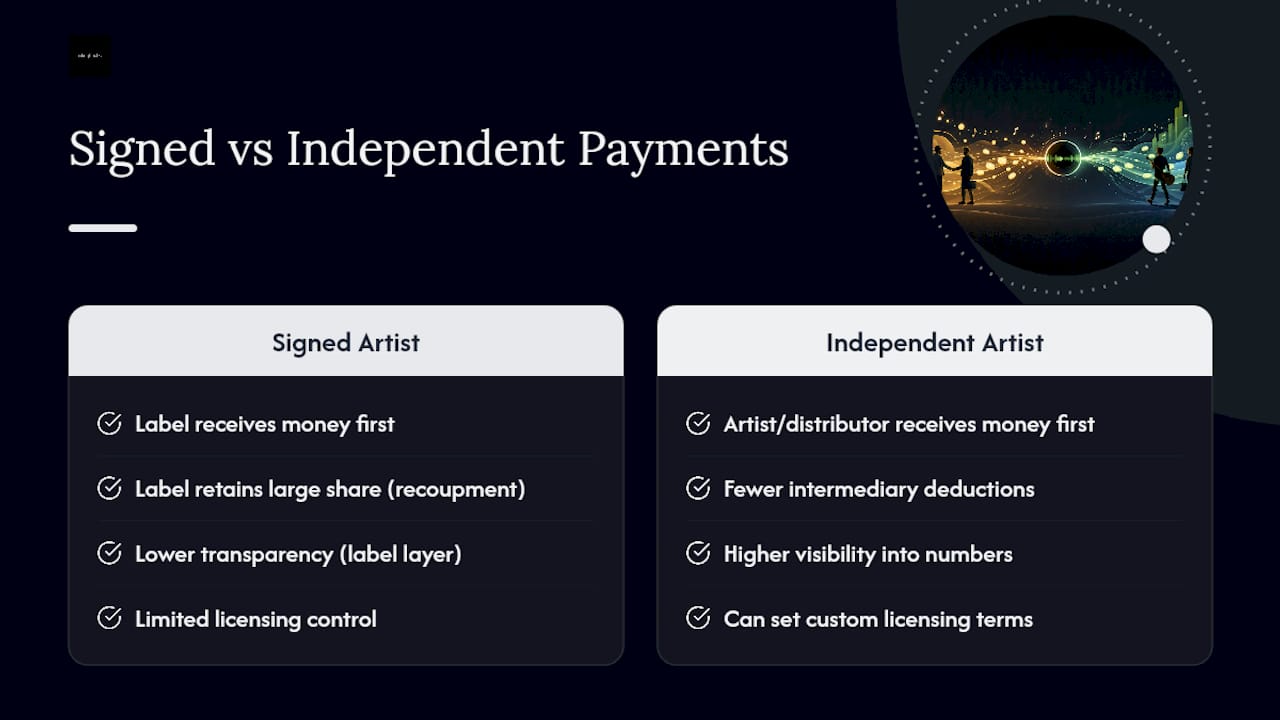
The Spotify streamshare model treats every stream identically regardless of who owns it. What changes is who receives the money first and how much gets deducted before it reaches the artist.
A signed artist, by contrast, often sees a label retain a significant share of recording royalties as recoupment against advances or recording costs before any money reaches the artist personally. That’s not a knock against labels, many provide services, like marketing and playlist pitching, that can grow total streams enough to offset the smaller percentage. But it does mean two artists earning identical gross royalties from Spotify can end up with dramatically different net income.
Independent artists also typically have more visibility into their own numbers. Without a label layer between the distributor and the artist, reconciling a Spotify for Artists stream count against an actual bank deposit tends to be far more straightforward. That transparency is part of why the ability to build custom licensing terms, of the kind independent producers and artists use when sourcing beats and instrumentals, matters so much for long-term income clarity. Knowing exactly what percentage of a track’s future royalties you control from day one avoids painful surprises later.
Why Do Spotify Payouts Take So Long to Arrive?
The lag between a stream happening and money hitting an artist’s account comes from three separate accounting cycles stacked on top of each other, not from any single point of delay.
First, Spotify closes its books on a monthly basis and calculates streamshare for that period, a process that itself takes several weeks after the month ends. Second, once Spotify pays the rights holder (a label, aggregator, or distributor), that entity has its own internal processing and reporting cycle before passing money along. Third, the artist’s payout method, whether a bank transfer, PayPal, or a distributor’s internal wallet, adds its own settlement time.
Stacked together, it’s common for streams generated in a given month to show up as available funds two to three months later. Distributors that batch payments quarterly rather than monthly stretch that timeline further. This is normal, not a sign something’s broken, but it does mean artists tracking cash flow for tax or budgeting purposes need to plan around a real lag rather than assuming payment is instant.
What Do People Get Wrong About Spotify Payouts?
The most persistent misconception is treating “Spotify pays $0.003 to $0.004 per stream” as a fixed universal rate. It isn’t. Spotify pays via streamshare, meaning your actual rate depends on the composition of the entire royalty pool that month, not a number Spotify sets in advance.
A second common error: assuming every stream counts equally toward royalties. Since April 2024, a track needs at least 1,000 streams in the trailing 12 months to generate recording royalties at all, so very low-volume catalogs may see $0 in recording income for eligible-but-under-threshold tracks even while accumulating plays.
Third, artists frequently confuse gross rights-holder payout with net artist take-home, forgetting that a distributor or label cut, and sometimes a separate publishing split, comes out before money reaches them personally. And finally, many assume a higher stream count always means more money, when in reality engagement quality, and listener geography, often swing total earnings more than volume alone.
How Do Playlists Affect Your Streaming Payout?
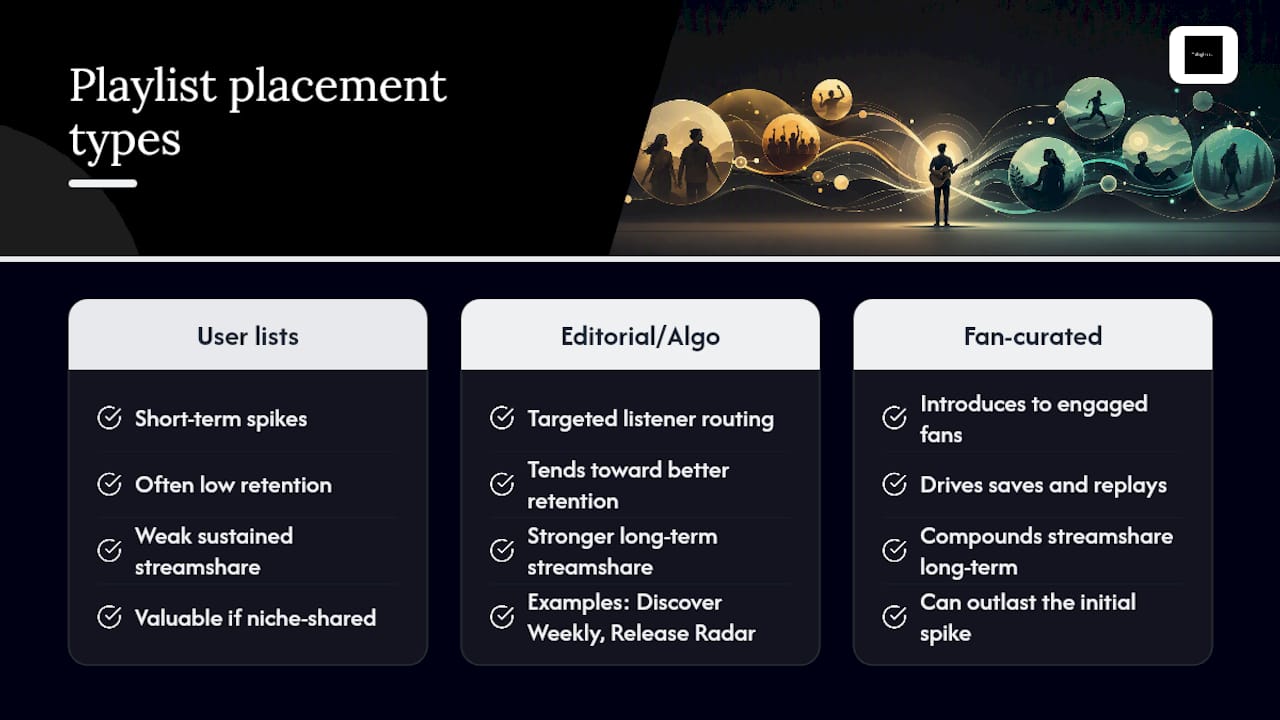
User-generated and algorithmic playlists don’t change the royalty rate per stream, but they shape the volume and consistency of streams that determine your overall streamshare. A track landing on a popular user-curated playlist can generate a short-term spike, but spikes from playlists with low listener retention often convert poorly into the repeat plays that sustain streamshare month over month.
Editorial and algorithmic playlists (like Discover Weekly or Release Radar) tend to route toward listeners already showing engagement signals with similar music, which is part of why streams from those placements often correlate with better long-term retention than a random user-generated playlist add. That doesn’t mean user playlists are worthless. A dedicated fan curating a playlist that gets shared within a genre community can introduce a track to exactly the audience most likely to save and replay it, compounding streamshare gains well past the initial spike.
The practical lesson: track not just how many streams a playlist placement generates, but whether those listeners come back. A placement that drives 20,000 one-time streams and vanishes contributes less to sustained payout than one driving 5,000 streams that turn into recurring monthly listens.
The Honest Take on Spotify Payout Math
Most advice on Spotify payouts fixates on chasing a higher per-stream rate, as if artists could negotiate their way to a better number. That’s backwards. The rate itself, whether it’s $3.63 or $4.43 per 1,000 streams, is largely outside any individual artist’s control. What is controllable is everything downstream: which distributor takes the smallest cut, whether publishing is registered at all, and whether promotional effort chases engagement in high-value markets instead of raw play counts anywhere.
The 1,000-stream eligibility change exposed how much conventional advice underweights catalog activity. A back catalog of songs sitting below that threshold isn’t just underperforming, it’s generating zero recording royalties, full stop. That single policy shift should reorder priorities for any artist with a deep but dormant catalog: reactivating old tracks toward 1,000 trailing streams may do more for annual income than a new release.
Run the numbers yourself before trusting anyone’s headline rate, including this one.
— Thomas
Turn Your Streaming Strategy Into Better Numbers
Understanding your Spotify streams payout only gets you halfway there. Getting more from every stream still starts with a track worth putting on repeat, and that means sourcing instrumentals built for genuine replay value, not just a quick first listen. Tellingbeatzz offers a catalog of beats built for independent artists who want unlimited commercial rights and full ownership over anything they release, with custom beat packs available for artists building out a full project rather than a single track. If you’re serious about growing the retention and engagement that drive long-term streamshare, pairing a transparent royalty strategy with a catalog of production-ready beats is a reasonable place to start. For a second opinion on your numbers, the Playlist Pilot royalty calculator offers another methodology worth cross-checking against your own distributor statements.
No Comments