


6 Step Release Checklist for Songwriters to Register With PROs
Register each song with your PRO before you release it. Join one performance rights organization (ASCAP, BMI, or SESAC), gather accurate metadata and writer splits, and submit every work through that PRO’s portal so live and streamed performances get tracked and paid. Then round out the picture with SoundExchange for your masters, The MLC for mechanicals, and, if you want stronger legal footing, a U.S. Copyright Office filing.
TL;DR:
- Register songs with your PRO before distribution to ensure early collection of performance royalties, especially for spins and playlist adds.
- Accurately entering metadata and writer splits, along with registration of recordings and compositions with SoundExchange and The MLC, minimizes royalty mismatches.
- Join only one PRO as a writer, and set up your publisher account simultaneously to avoid missed or unclaimed publisher royalties.
- Correctly specify song titles, writer details, splits, identifiers, and registration numbers across PRO, SoundExchange, and The MLC to prevent royalty loss.
- File copyright registrations at the same time as PRO registration to secure legal ownership and maximum protection against infringement.
Table of Contents
- What Is the Process for Registering Songs With PROs?
- Which PRO Should You Join, and Do You Need a Publisher Account?
- What Metadata Do PRO Registration Forms Actually Require?
- How Do SoundExchange and The MLC Fit Alongside PRO Registration?
- What Are the Most Common PRO Registration Mistakes?
- Do You Need to Register With the U.S. Copyright Office Too?
- A Publisher’s View: Where Registration Belongs in Your Release Calendar
- Tellingbeatzz Makes Your Metadata Cleaner From the First Session
- Sources
What Is the Process for Registering Songs With PROs?
Think of registration as paperwork that pays you back, one confirmation number at a time. Do it in this order, in a single sitting if you can:
- Open or verify your writer account with your chosen PRO, and set up a publisher account too if you’re collecting both shares.
- Pull together your metadata and a written split sheet: legal names, IPI/CAE numbers, agreed percentages, ISRCs, and an ISWC if you already have one.
- Enter the composition into the PRO’s portal and save the confirmation number that comes back.
- Register the recording with SoundExchange and the composition with The MLC.
- File a U.S. Copyright Office claim if you want the statutory protections that PRO registration alone doesn’t provide.
- Check that the work shows up correctly in your PRO’s repertory, and flag any mismatch immediately.
Pro Tip: Do this the same week you finalize the mix, not the week the single drops. Performance royalties for early spins and playlist adds are rarely paid retroactively once a work is registered late.
Which PRO Should You Join, and Do You Need a Publisher Account?
You can only join one PRO as a writer at a time, so the choice matters more than most songwriters expect. Here’s how the three break down:
- BMI: free to join as a songwriter, with a separate paid application for a publisher entity.
- ASCAP: a one-time membership fee for writers, with publisher registration handled as its own account.
- SESAC: operates on an invitation or affiliate model rather than open enrollment, so most writers undergo evaluation before joining.
None of the three pays out meaningfully more than the others on identical performance data. What actually costs you money is skipping the publisher side. Performance royalties split 50/50 between the writer’s share and the publisher’s share, and if you never register a publisher entity, that publisher half often goes uncollected or sits unclaimed. If you’re self-publishing, set up your publisher account at the same PRO the moment you register as a writer. Switching PROs later is possible but adds a resignation window and paperwork most writers would rather avoid.
What Metadata Do PRO Registration Forms Actually Require?
Every rejected or mismatched registration traces back to one of six fields. Get these right and the rest of the process runs itself:
- Song title and alternate titles: use the exact spelling as released, and list any working title separately so the PRO can match it later.
- Writers: legal name plus performing name, and each writer’s IPI/CAE number where one exists.
- Splits: percentages confirmed in writing with every co-writer, entered so they add up to exactly 100 percent across all registering parties.
- Publisher name and publisher IPI: required if you’re claiming the publisher share yourself.
- Identifiers: an ISRC for the recording and an ISWC for the composition. If you don’t have an ISWC, most PROs will assign one once the work is registered.
- Confirmation numbers and PRO work ID: save both. You’ll need them if a payment ever needs tracing.
Split accuracy matters more than any other field on the form. Registration guidance from ASCAP notes that most royalty shortfalls trace back to mismatched metadata or incorrect percentages, not underpayment or missed spins. And when co-writers are affiliated with different PROs, each society still needs to see the identical agreed split so reciprocal agreements route the money correctly on both sides.
How Do SoundExchange and The MLC Fit Alongside PRO Registration?
PRO registration covers performance royalties, but that’s only one stream of income a released song generates. Two more need separate registrations, and creators skip them constantly.
-
SoundExchange collects digital performance royalties for the master recording, not the composition. Register each recording with its ISRC and specify whether you’re the rights owner, a featured artist, or both, since SoundExchange pays each role differently.
-
The MLC administers mechanical royalties from streaming. Register the composition directly, or confirm your publishing administrator handles it, because The MLC pays out based on whoever is registered as the controlling party.
-
PRO registration still stands on its own. SoundExchange and The MLC don’t track performances, so skipping your PRO means leaving that royalty type uncollected no matter how thorough the other two filings are.
Handle them in this order for the cleanest paper trail: PRO first, then The MLC, then SoundExchange, linking the same ISRC and ISWC across all three wherever the fields allow it.
What Are the Most Common PRO Registration Mistakes?
Most lost royalties never come from underplayed songs. They come from paperwork that doesn’t match itself. A few habits fix nearly all of it:
- Lock every split in a written split sheet before you register anything, and use identical legal names and IPI numbers across every system.
- Log into your PRO’s repertory search periodically and confirm the work title, writers, and splits appear exactly as submitted.
- If something’s off, open a correction request or support ticket right away. Waiting a quarter means waiting through a full payment cycle before it’s fixed.
Pro Tip: Correction requests can take several weeks to process, and PROs generally require identity or contractual proof before changing a split. Build that lag into your expectations rather than assuming a same-day fix. Account activation itself is usually fast, but repertoire visibility and the first payment cycle can lag by a full quarter or more, so a mismatch caught early saves real money.
Do You Need to Register With the U.S. Copyright Office Too?
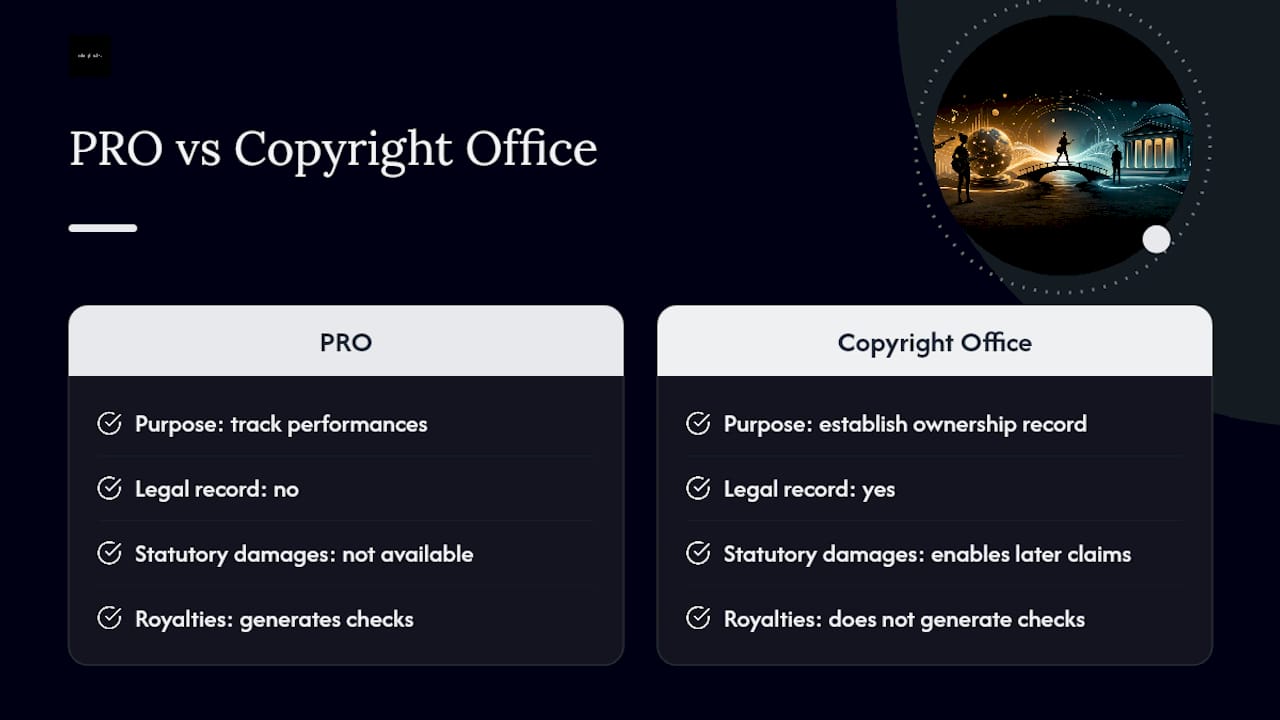
Copyright registration and PRO registration solve different problems. A PRO registration gets your performances tracked and paid; it does nothing to establish your legal ownership claim. Filing with the U.S. Copyright Office through its Electronic Copyright Office system creates that legal record, and it’s what opens the door to statutory damages if someone infringes your work later.
If you’re releasing several songs on one album, Circular 50 allows group registration of up to ten unpublished works by the same authors under one filing fee, which is worth using before individual singles come out. The practical rule: register with the Copyright Office when you want maximum legal protection or expect a dispute is likely. Register with your PRO regardless, since that’s the only filing that actually generates royalty checks.
A Publisher’s View: Where Registration Belongs in Your Release Calendar
Registration works best as a release-day habit, not an afterthought. Capture every metadata field and finalize splits in the same session you lock the final mix, while every co-writer is still paying attention. Complete your PRO and MLC registrations before the song goes to distributors, not after. Clean metadata submitted early is the difference between a smooth royalty statement and months chasing a correction ticket.
— Thomas
Tellingbeatzz Makes Your Metadata Cleaner From the First Session
Registration only runs smoothly when the underlying rights are clean, and that starts with the beat. Tellingbeatzz sells licensed instrumentals with transparent terms spelled out at checkout, so the publisher and writer fields you enter into your PRO account never carry a question mark about who actually controls the composition.
Because every license includes unlimited commercial rights and clear documentation of what you’ve purchased, there’s no ambiguity to untangle when you’re filling out split sheets or naming a publisher entity later. That clarity carries into how you handle release-workflow decisions too, since a beat with murky licensing terms is one of the fastest ways to create a metadata mismatch you’ll be fixing for months. If you’re building your next release around a fresh instrumental, browse Tellingbeatzz’s full catalog of licensed beats and start your registration paperwork with rights you can actually stand behind.
No Comments