

5 Hip Hop Song Structures Indie Artists Can Record in One Session
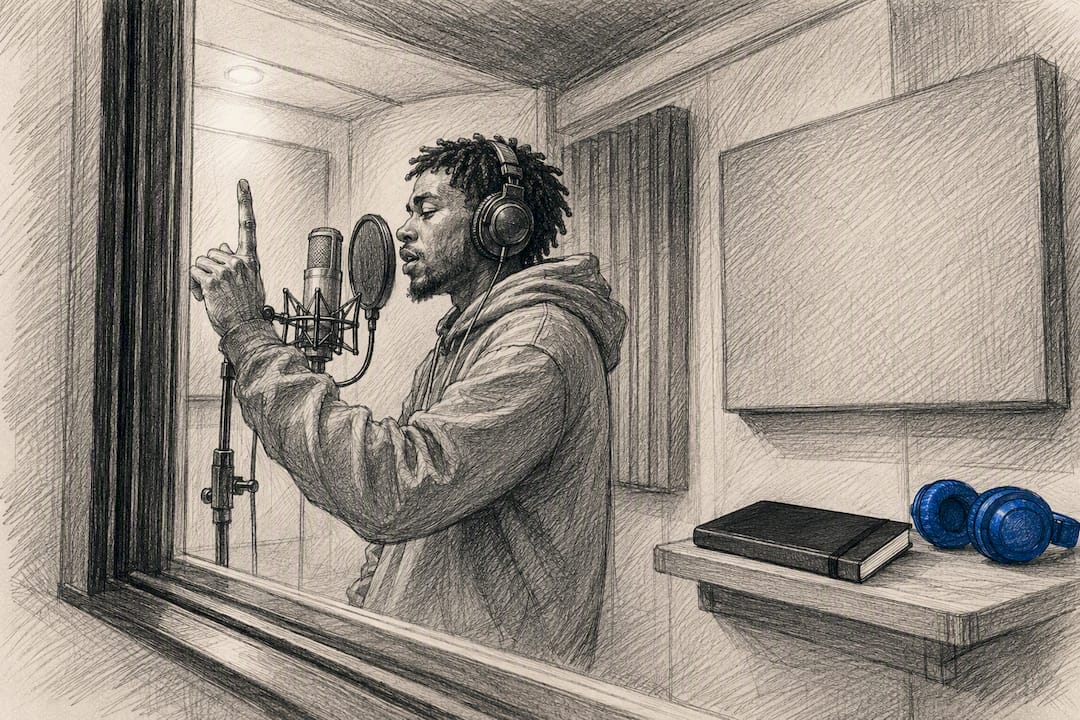
Artist recording a hook in vocal room

5 Hip Hop Song Structures Indie Artists Can Record in One Session

Most rap songs run on a verse-hook paradigm: sixteen bars of lyrics, eight bars of hook, repeat. A 2021 corpus study of 160 hip-hop songs found 77% follow this pattern, with 15% strophic and 8% built on long verses or atypical forms. Trap tightens verses to 8 or 12 bars; boom-bap and storytelling tracks stretch them. The templates below adapt the default for each case.


TL;DR:

  • Most rap songs follow a verse-hook pattern, but different subgenres like trap or storytelling use modified structures tailored to their goals.
  • When writing, match your verses’ length and pace to your BPM to avoid rushing or dragging, using the seconds-per-bar formula for precision.
  • Build your song structure based on the beat’s arrangement cues and choose templates like classic, hook-first, or long-verse to suit your lyrical or streaming aims.
  • Craft memorable hooks no longer than four bars placed early enough to engage listeners quickly, especially for platforms like TikTok and Spotify.
  • Use clear, instrumentally defined beats for easier structure planning and consider adding pre-choruses or ad-libs to enhance emotional buildup or vocal density.

Table of Contents

Quick Templates: Five Ready-to-Use Rap Song Structures

Structure is a container, not a cage. Pick the one that matches your intent, then fill it. These five cover almost everything you’ll build in the studio this year.

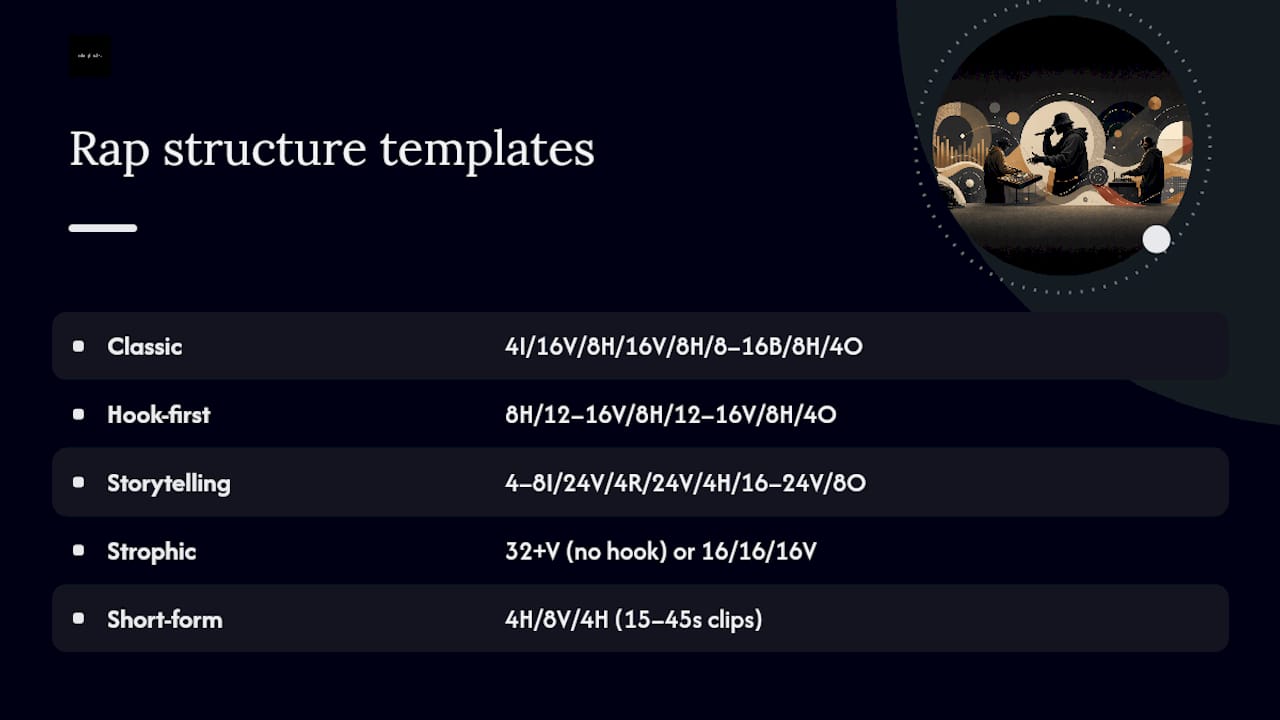
1. Classic verse-hook. Intro (4 bars) → Verse 1 (16 bars) → Hook (8 bars) → Verse 2 (16 bars) → Hook (8 bars) → Bridge or Verse 3 (8 to 16 bars) → Final hook (8 bars) → Outro (4 bars). This is the default framework most songwriting guides teach, and it works for nearly any subgenre because it gives listeners a predictable rhythm of tension and release.
Five rap song structure bar patterns

2. Hook-first, streaming-optimized. Hook (8 bars) → Verse 1 (12 to 16 bars) → Hook (8 bars) → Verse 2 (12 to 16 bars) → Hook (8 bars) → Outro (4 bars). The hook lands before the 30-second mark, sometimes at 0:00. Use this when the release goal is Spotify or TikTok traction rather than lyrical showcase.

3. Storytelling/long-verse. Intro (4 to 8 bars) → Verse 1 (24 bars) → Hook or refrain (4 bars) → Verse 2 (24 bars) → Hook (4 bars) → Verse 3/resolution (16 to 24 bars) → Outro (8 bars). The hook shrinks so the narrative doesn’t get interrupted. Reserve this for concept tracks where plot matters more than repetition.

4. Strophic/long-verse for freestyles. Verse (32+ bars, no hook) or Verse 1 (16) → Verse 2 (16) → Verse 3 (16), with no chorus separating them. Common in battle rap, freestyle cyphers, and mixtape cuts built for lyrical density over replay value.

5. Short-form hook-driven for social clips. Hook (4 bars) → Verse (8 bars) → Hook (4 bars). Built for 15 to 30 second clips. The entire “song” might only run 45 seconds, front-loaded so the strongest line hits within the first two seconds of playback.

Pro Tip: Write your hook before you write a single verse bar. Anchoring the song to the hook first, then drafting verses in 16-bar chunks and trimming afterward, keeps every verse pointed at the same payoff instead of wandering.

How Do You Convert Bars to Seconds?

A bar in standard 4/4 time holds four beats. Sixteen bars, the most common verse length, equals 64 beats total. Once you know the tempo, that beat count converts directly to runtime, which is how you check whether a verse will feel cramped or draggy before you record a single take.

The formula is simple: seconds per bar = (60 ÷ BPM) × 4. Multiply that by your bar count and you know exactly how long a verse or hook will run on the beat.

That gap explains why a 16-bar verse written for a boom-bap beat at 90 BPM can feel like it drags forever when dropped onto a drill beat at 140 BPM without rewriting the phrasing. Faster tempos demand tighter syllable count per bar, or the verse will rush past the pocket. Slower tempos give you room to stretch words out, but too much space invites filler. Before you record, count your bars, check the math against your tempo, and read the lyrics aloud against a click. If a verse feels crowded at the mic, it usually means the syllable density doesn’t match what the tempo allows, not that you need more bars.

Which Structure Fits Your Subgenre?

The verse-hook default is a starting point, not a rulebook. Every major subgenre bends it based on what the song is trying to accomplish, whether that’s streaming numbers, lyrical respect, or narrative weight.

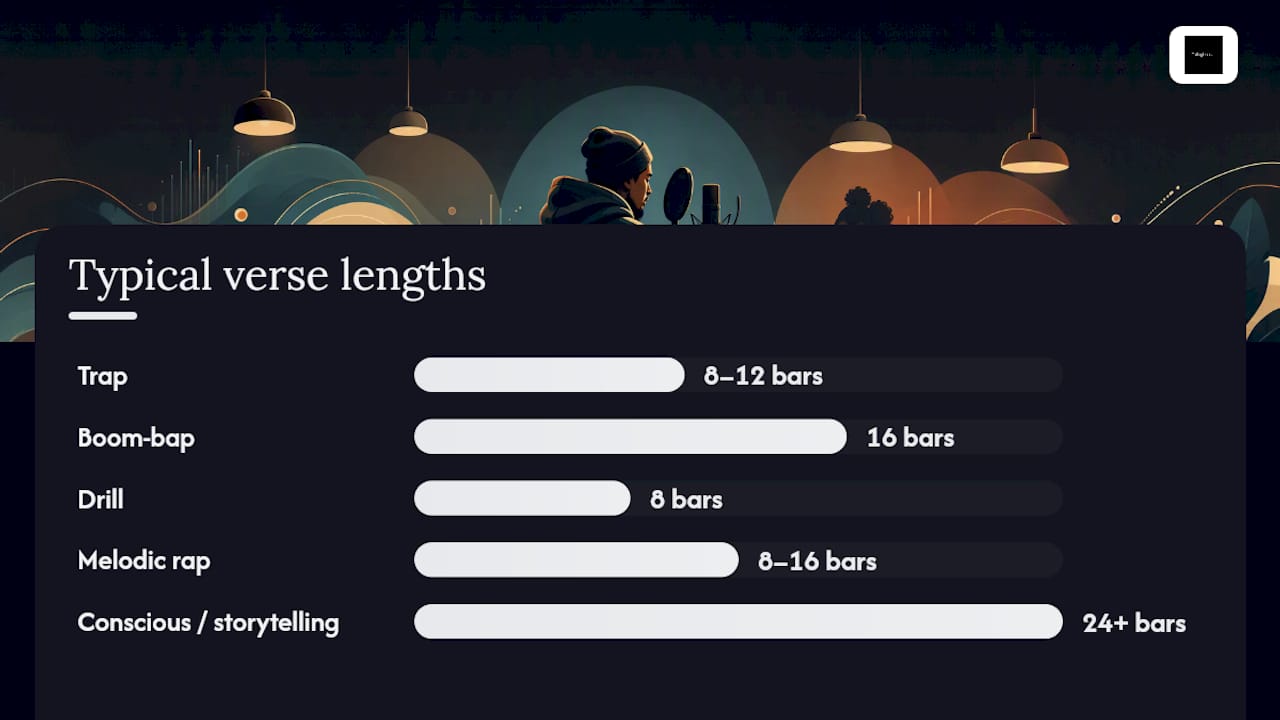
Trap favors speed to the payoff. Verses run 8 to 12 bars, hooks arrive early (often at 0:00 to 0:20), and hooks repeat more often than in any other subgenre. Streaming metrics reward this: a hook that hits before the algorithm registers a skip protects completion rate, and repetition trains the listener to remember the song faster. Ad-libs stack heavily behind the lead vocal to fill space trap beats leave open.

Boom-bap trusts the listener to stay for the verse. Sixteen-bar verses are standard, hooks often land closer to 0:40 to 1:10, and hooks stay shorter and less repetitive because the genre prioritizes lyrical density over hook memorability. Ad-libs are sparse, sometimes absent entirely.

Drill borrows trap’s early-hook instinct but pushes tempo and aggression further, with verses often clipped to 8 bars and triplet flows dominating the pocket. Hooks tend to be rhythmic chants rather than melodic phrases.

Melodic rap blurs the line between hook and verse entirely. Melodic hooks can run longer, sometimes 8 to 16 bars, and pre-hooks or vocal runs bridge sections instead of a hard cut. Structure here often serves the melody’s emotional arc more than a strict bar count.

Conscious and storytelling rap slows everything down. Verses stretch to 24 bars or beyond, hooks shrink to short refrains so the narrative isn’t interrupted, and the song’s structure follows the story’s plot points rather than a repeatable pattern. This is also where subject matter and structural choices intersect most directly with cultural narrative techniques, similar to how brands outside music use storytelling to build authentic identity.

If chart or streaming performance is the goal, build on the trap or hook-first template. If lyrical reputation is the goal, boom-bap or strophic forms give you the room. If the song exists to tell a story, choose long-verse and let the hook shrink out of the way.
Which Structure Fits Your Subgenre? — overview diagram

How Do You Write a Hook That Actually Sticks?

A hook has one job: get remembered inside four bars. Anything longer starts to function like a second verse, and anything shorter risks feeling incomplete. Keep the core phrase to 2 to 4 bars, whether it’s melodic or purely rhythmic, and repeat that phrase at least twice within the hook itself before moving on.

Placement decides whether the hook even gets heard. The first hook should generally land before the one-minute mark, and subgenre shifts that window further: trap often opens directly on the hook at 0:00, while boom-bap can wait until 0:40 or later because it trusts listeners to stay through a denser opening verse. Streaming platforms track skip rate in the opening seconds, so pushing your hook too late is a real risk if the release goal is algorithmic reach rather than a lyrical showcase.

Test the hook before you commit a full session to it:

  • Say it out loud with no beat. If it doesn’t stick after two readings, it won’t stick with a beat behind it either.
  • Loop just the hook for 30 seconds. If you’re already bored, a listener will be too.
  • Play it for someone who hasn’t heard the song and ask them to repeat it back an hour later.
  • Check whether it works isolated from the verse. A hook that only makes sense in context isn’t doing its job.

Statistic to remember: across the 160-song corpus behind the verse-hook study, the dominant 77% share of verse-hook songs suggests listeners have been trained by sheer repetition to expect a hook early and often. Fighting that expectation is possible, but it’s a deliberate risk, not an accident.

What Makes a Rap Verse Actually Work?

A strong 16-bar verse behaves like a three-act structure compressed into 40 or so seconds. Act one, bars 1 through 5 or so, sets the scene or states the premise. Act two, the middle stretch, builds detail, tension, or wordplay. Act three, the closing bars, delivers the line you actually wrote the verse to reach. Too many writers front-load their best bar and coast to the end. Flip that habit and the hook feels earned instead of arbitrary.

Flow variation matters as much as content. A common production technique is switching flow or rhythmic feel around bar 9, roughly the midpoint of a 16-bar verse, to reset listener attention before monotony sets in. That might mean shifting from straight eighth-note delivery to a triplet pocket, or dropping the cadence entirely for two bars of near-spoken delivery before snapping back. Micro-timing, deliberately rushing or dragging a syllable against the beat, does the same job on a smaller scale within a single bar.

Pro Tip: Draft each verse a few bars longer than you need, then cut. Writing 20 bars and trimming to 16 almost always produces a tighter verse than writing exactly 16 from the start, because you’re editing for impact instead of padding to hit a count.

Read every draft against the actual beat, not silently on a page. Phrasing that scans fine on paper often collides with the pocket once a hi-hat pattern or bass hit lands in an unexpected place. If a line stumbles on the third read-aloud, it will stumble in the booth too.

How to Build a Rap Song from Beat to Final Mix

  1. Mark the structure on the beat itself. Before writing a word, count bars on the instrumental and note where the intro ends, where a hook slot naturally opens, and where any beat switch or breakdown lives.
  2. Choose your template. Match one of the five structures above to your release goal, streaming reach, lyrical showcase, or narrative depth.
  3. Write the hook first. Lock the core phrase and melody or cadence before drafting a single verse bar.
  4. Draft verses longer than needed. Write 20 to 24 bars per verse slot, then cut down to your target count, keeping the strongest lines and the cleanest flow.
  5. Record a rough skeleton. Lay down scratch vocals over the full arrangement to hear how sections actually connect, not just how they read.
  6. Refine against playback. Fix timing issues, tighten transitions, and adjust ad-lib placement once you can hear the whole song end to end.
  7. Finalize the arrangement. Confirm bar counts, hook placement, and total runtime before comping final vocal takes.

Most independent artists need three to five takes per verse to land a clean comp, more if the flow includes fast triplet sections. Before calling a track done, run one last check: does the hook land inside your subgenre’s window, does the runtime match the release format, and does every section serve the structure you picked in step two?

How Do Beat Choices Shape Song Structure?

Instrumentals often decide structure before a single lyric gets written. A beat’s intro length, breakdown point, and drop placement effectively force the arrangement, telling you where a hook has to sit and how long a verse can breathe before the beat shifts under it.

Licensed, template-ready beat packs remove a layer of friction from that process:

  • Beats built with clear intro, verse, and hook sections cut arrangement guesswork.
  • Transparent commercial licensing means no legal uncertainty once the track is released.
  • Instant delivery in MP3, WAV, or trackout formats keeps the studio session moving without delay.

A catalog of hundreds of instrumentals is available, built around arrangement cues that help independent releases reach wide streaming numbers.

Why Pre-Chorus Sections Matter More Than You Think

A pre-chorus isn’t standard in every rap song, but where it appears, it does real structural work. Its job is to raise energy just before the hook lands, usually across 2 to 4 bars, so the drop into the chorus feels inevitable instead of abrupt.

Melodic rap and hip-hop tracks with pop-adjacent production lean on pre-choruses most often, since a melodic hook benefits from a runway. A rising vocal line, a shift in cadence, or even a single repeated word building in intensity can signal to the listener that the payoff is close. Boom-bap and lyric-forward tracks tend to skip this element entirely, cutting straight from verse to hook because the genre trusts contrast rather than buildup to make the hook land.

The risk with pre-choruses is treating them like a second verse. Once a transitional section runs past 4 bars, it starts competing with the hook for attention instead of setting it up. If you’re testing whether your song needs one, try cutting it in a rough mix and see if the jump from verse to hook feels sudden. If it does, a short transitional phrase, even just a repeated ad-lib rising in volume, usually solves the problem without adding real bar count.

Where Do Ad-Libs and Vocal Effects Belong?

Ad-libs fill the space a lead vocal leaves open, and their placement changes meaning depending on where they sit in the structure. Under the hook, they reinforce the core phrase, doubling key words or echoing the last syllable of a line. Under a verse, they punctuate punchlines, dropping in right after a strong bar to give it room to land before the next line starts.

Trap and drill lean hardest on ad-libs, often stacking two or three per bar behind the lead vocal to match the density of the beat itself. Boom-bap and storytelling tracks use them sparingly, sometimes not at all, because a cluttered ad-lib track works against the clarity a dense verse needs.

Vocal effects follow a similar logic. Distortion, pitch shifting, or heavy delay on an ad-lib usually signals hook or chorus territory, since it separates that section sonically from the more natural-sounding verse vocal. Reserve the cleanest, most unprocessed vocal take for the verse where lyrics need to be understood clearly, and save the effects budget for sections built to be felt rather than parsed word for word.

How Do Beat Switches Change the Structure?

A beat switch, where the instrumental changes tempo, key, or entire production style mid-song, breaks the standard verse-hook template on purpose. It usually shows up at a structural seam: after a final hook, at the top of a closing verse, or right before an outro, giving the listener a clear signal that the song is entering a new phase.

Beat switches work best when they track an emotional or narrative shift in the lyrics rather than existing purely for novelty. A storytelling track might switch beats to mark a change from setup to consequence. A trap track might switch tempo to shift from a moody opening into a higher-energy back half built for the hook to hit harder the second time around.

The risk is treating a beat switch as a substitute for structure rather than part of it. A switch with no lyrical or emotional justification behind it tends to feel like two unfinished songs stitched together instead of one complete arrangement. If you’re building toward a switch, plan the moment during the writing stage, not as an afterthought in the mix, so the vocal performance and the production shift land together.

How Does Structure Serve the Story You’re Telling?

Structure and lyrical content aren’t separate decisions. The shape you choose for a song either supports the story you’re telling or actively fights against it, and the mismatch is usually obvious to a listener even when they can’t name why a track feels off.

A narrative that builds toward a twist or a resolution needs room, which is why storytelling and conscious rap lean on long-verse and strophic templates that stretch past the standard 16 bars. Cutting a narrative verse down to fit a tight hook-first template usually means cutting the plot itself, which defeats the purpose of writing a story track in the first place.

Conversely, a song built around a single emotional hook, a boast, a mood, a hook-driven flex, doesn’t need narrative room. Forcing a 24-bar verse onto a track that’s really about repetition and vibe usually just dilutes the hook’s impact by delaying it. Match the container to the content: a plot needs space, a mood needs a hook and repetition, and a lyrical showcase needs bars with room to breathe between punchlines.

What Can Classic Song Structures Teach You?

Studying how established songs are built reveals patterns you can borrow without copying a single line. A track built on the classic verse-hook template typically front-loads its most memorable phrase into an early hook, then uses each subsequent verse to add new detail while the hook stays fixed as the emotional anchor point.

Storytelling-driven tracks often abandon the repeated hook almost entirely, favoring a short recurring refrain that shifts meaning slightly each time it returns, because the surrounding verse content has changed the context. That’s a structural trick worth borrowing: a four-bar refrain that means something different in verse three than it did in verse one adds depth without adding bar count.

Tracks built for pure lyrical density often skip the hook altogether, relying on strophic form where verse after verse stacks with no chorus to break the flow. This works when the writing itself carries enough variation in flow and subject matter to avoid monotony, which is exactly why the bar-9 flow switch technique matters so much in longer verses.

The common thread across nearly every well-built rap song, regardless of era or subgenre: the structure was a decision, not a default. Every section earns its bar count because it serves a specific job in the song.

A Producer’s Take on Getting Structure Right

Most aspiring artists overthink the melody and underthink the map. Structure isn’t the creative part, it’s the scaffolding that lets the creative part land. A brilliant verse buried in a badly placed hook window still underperforms a decent verse structured correctly.

The mistake I see most often is treating one template as gospel because it worked once. The five templates above exist because different songs need different containers. Run the same beat through a hook-first version and a long-verse version before committing. You’ll often find the beat itself was telling you which one fits, you just hadn’t marked the structure on it yet.

Start there. Count the bars before you write the first line.

— Thomas

Where to Find Beats Built for These Templates

Building any of these five structures starts with an instrumental that already has clear section breaks, since a beat with a defined intro, hook slot, and breakdown point removes half the arrangement guesswork before you write a single bar. A catalog of hip-hop, rap, R&B, and soulful instrumentals is available, each licensed with unlimited commercial rights and delivered instantly in MP3, WAV, or full trackout format.
Tellingbeatzz

Licenses include clear terms spelled out before checkout, with no ongoing fees tied to success. Licensed beats with clear structural foundations offer an efficient production approach.

If you’re ready to apply one of the templates above to an actual session, browse the current beat catalog and build a custom pack around the tempo and subgenre your next song needs.

Sources

No Comments

Leave a Reply

Choose A License

Mp3 Unlimited (+3 FREE)

MP3
License Terms

Unlimited License Agreement

This Unlimited License Agreement (the “Agreement”) is entered into on [Purchase Date] between Thomas Hodek, professionally known as Tellingbeatzz (“Licensor”) and [Customer Full Name] (“Licensee”).
The Licensee has purchased an MP3 Unlimited License for the instrumental titled “[Beat Title]” (“Beat”) for a license fee of [Purchase Price] under Order #[Order Number].
Upon successful payment, this Agreement becomes effective immediately and is delivered electronically together with the licensed Beat files.

1. Grant of License

The Licensor grants the Licensee a non-exclusive, worldwide, non-transferable and perpetual license to use the Beat to create and commercially exploit one or more new songs incorporating the Beat (“New Song”).
The Licensee may add vocals, lyrics, melodies, instrumentation, arrangements and other original contributions to the Beat.
The Beat itself remains the intellectual property of the Licensor and is not sold or transferred to the Licensee.

2. Unlimited Commercial Use

The Licensee may commercially release and use the New Song without limits on:
  • digital or physical distribution
  • sales
  • audio streams
  • monetized video streams
  • music videos
  • live or paid performances
  • radio and online broadcasts
  • social media content
  • albums, EPs, mixtapes and singles
There are no limits on streams, sales, downloads, views or performances generated by the New Song.

3. Master Recording and Revenue

The Licensee may create and commercially exploit a new master recording incorporating the Beat (“Master Recording”).
The Licensee retains the revenue generated directly from exploitation of the Master Recording, including streaming, digital distribution and physical sales, subject to any publishing, mechanical, performance or other composition-based royalties attributable to the Licensor’s share of the underlying composition.
The Licensor does not acquire ownership of the Licensee’s original lyrics, vocals or other independently created contributions.

4. Ownership

The Licensor retains all rights, title and interest in the original Beat, including the applicable copyright interests in the musical composition and sound recording.
This Agreement does not transfer ownership or copyright in the Beat to the Licensee.
The Licensee may protect or register their own original contributions to the New Song but may not claim sole ownership or authorship of the underlying Beat.

5. Publishing and Songwriting

For each New Song created under this Agreement, the underlying composition shall be divided as follows:
Licensee: 50%
Licensor: 50%
The Licensee agrees to properly identify the Licensor’s share when registering the New Song with a Performing Rights Organization, publisher, publishing administrator or other rights-management organization.
Licensor PRO Information:
Writer / Composer: Thomas Hodek
Producer Name: Tellingbeatzz
PRO: GEMA (Germany)
IPI / CAE: 716014087
Publishing Administrator: BeatStars Publishing Worldwide

6. Credit

Where credits are customarily provided, the Licensee agrees to credit the Producer as:
Produced by Tellingbeatzz
or
Beat by Tellingbeatzz
If additional featured-vocalist or hook credits are supplied with the Beat, those credits must also be included where reasonably applicable.

7. Content ID

Because the Beat may be licensed non-exclusively to multiple artists, the Licensee may not register the Beat or any New Song containing the Beat with YouTube Content ID or any similar automated copyright-claiming or fingerprinting system without prior written permission from the Licensor.
The Licensor reserves the right to register and administer the Beat through Content ID or similar systems.
If the Licensee receives a claim relating to a valid licensed use, proof of purchase may be submitted for review and release where appropriate.

8. Synchronization

The Licensee may synchronize the New Song with:
  • music videos
  • YouTube videos
  • social media content
  • podcasts
  • online promotional content
  • independent films and video projects
Major third-party commercial synchronization uses, including national advertising campaigns, television productions, feature films, major video games or comparable commercial projects, require prior written approval from the Licensor.

9. Prohibited Uses

The Licensee may not:
  1. resell, redistribute or sublicense the Beat in its original or substantially similar instrumental form;
  2. upload or distribute the Beat as a standalone instrumental under the Licensee’s name;
  3. include the Beat in beat packs, sample packs, loop libraries, sound libraries or production libraries;
  4. claim authorship or ownership of the original Beat;
  5. register the Beat or New Song with Content ID without permission;
  6. transfer this License to another person or entity without written consent;
  7. share the Beat files with third parties except persons directly involved in producing, recording, mixing, mastering or distributing the New Song.

10. Files Included

The files delivered depend on the license purchased:
MP3 Unlimited: MP3
WAV Unlimited: MP3 + WAV
Trackout Unlimited: MP3 + WAV + available tracked-out stems
The file format supplied does not change the commercial usage rights granted under this Agreement.

11. Non-Exclusive License

This is a non-exclusive license.
The Licensor may continue licensing or selling the same Beat to other customers.
The Licensee acknowledges that other artists may legally release different songs using the same Beat.

12. Future Exclusive Sale

If exclusive rights to the Beat are sold after this Agreement has taken effect, this License remains valid.
The Licensee may continue using, distributing and monetizing the New Song according to the terms of this Agreement.

13. Samples and Third-Party Material

Where the Beat contains third-party material requiring clearance, the Licensee is responsible for obtaining any additional clearance required for the Licensee’s intended use unless otherwise agreed in writing.
The Licensor will disclose known third-party clearance requirements where reasonably possible.

14. Term

This License is valid in perpetuity, provided the Licensee complies with this Agreement.
No renewal payment is required.

15. Breach

If the Licensee materially breaches this Agreement, the Licensor may provide written notice and, where the breach can reasonably be corrected, allow 30 days to cure the violation.
If the breach is not corrected within that period, the Licensor may terminate the License and pursue available remedies.

16. Governing Law

This Agreement is governed by the laws of the Federal Republic of Germany, without prejudice to mandatory consumer protection laws applicable to the Licensee.

17. Entire Agreement

This Agreement, together with the applicable WooCommerce order confirmation, constitutes the complete agreement between the Licensor and Licensee regarding the licensed Beat.
If any provision is found invalid or unenforceable, the remaining provisions remain effective.

WAV Unlimited (+6 FREE)

WAV, MP3
License Terms

Unlimited License Agreement

This Unlimited License Agreement (the “Agreement”) is entered into on [Purchase Date] between Thomas Hodek, professionally known as Tellingbeatzz (“Licensor”) and [Customer Full Name] (“Licensee”).
The Licensee has purchased an WAV Unlimited License for the instrumental titled “[Beat Title]” (“Beat”) for a license fee of [Purchase Price] under Order #[Order Number].
Upon successful payment, this Agreement becomes effective immediately and is delivered electronically together with the licensed Beat files.

1. Grant of License

The Licensor grants the Licensee a non-exclusive, worldwide, non-transferable and perpetual license to use the Beat to create and commercially exploit one or more new songs incorporating the Beat (“New Song”).
The Licensee may add vocals, lyrics, melodies, instrumentation, arrangements and other original contributions to the Beat.
The Beat itself remains the intellectual property of the Licensor and is not sold or transferred to the Licensee.

2. Unlimited Commercial Use

The Licensee may commercially release and use the New Song without limits on:
  • digital or physical distribution
  • sales
  • audio streams
  • monetized video streams
  • music videos
  • live or paid performances
  • radio and online broadcasts
  • social media content
  • albums, EPs, mixtapes and singles
There are no limits on streams, sales, downloads, views or performances generated by the New Song.

3. Master Recording and Revenue

The Licensee may create and commercially exploit a new master recording incorporating the Beat (“Master Recording”).
The Licensee retains the revenue generated directly from exploitation of the Master Recording, including streaming, digital distribution and physical sales, subject to any publishing, mechanical, performance or other composition-based royalties attributable to the Licensor’s share of the underlying composition.
The Licensor does not acquire ownership of the Licensee’s original lyrics, vocals or other independently created contributions.

4. Ownership

The Licensor retains all rights, title and interest in the original Beat, including the applicable copyright interests in the musical composition and sound recording.
This Agreement does not transfer ownership or copyright in the Beat to the Licensee.
The Licensee may protect or register their own original contributions to the New Song but may not claim sole ownership or authorship of the underlying Beat.

5. Publishing and Songwriting

For each New Song created under this Agreement, the underlying composition shall be divided as follows:
Licensee: 50%
Licensor: 50%
The Licensee agrees to properly identify the Licensor’s share when registering the New Song with a Performing Rights Organization, publisher, publishing administrator or other rights-management organization.
Licensor PRO Information:
Writer / Composer: Thomas Hodek
Producer Name: Tellingbeatzz
PRO: GEMA (Germany)
IPI / CAE: 716014087
Publishing Administrator: BeatStars Publishing Worldwide

6. Credit

Where credits are customarily provided, the Licensee agrees to credit the Producer as:
Produced by Tellingbeatzz
or
Beat by Tellingbeatzz
If additional featured-vocalist or hook credits are supplied with the Beat, those credits must also be included where reasonably applicable.

7. Content ID

Because the Beat may be licensed non-exclusively to multiple artists, the Licensee may not register the Beat or any New Song containing the Beat with YouTube Content ID or any similar automated copyright-claiming or fingerprinting system without prior written permission from the Licensor.
The Licensor reserves the right to register and administer the Beat through Content ID or similar systems.
If the Licensee receives a claim relating to a valid licensed use, proof of purchase may be submitted for review and release where appropriate.

8. Synchronization

The Licensee may synchronize the New Song with:
  • music videos
  • YouTube videos
  • social media content
  • podcasts
  • online promotional content
  • independent films and video projects
Major third-party commercial synchronization uses, including national advertising campaigns, television productions, feature films, major video games or comparable commercial projects, require prior written approval from the Licensor.

9. Prohibited Uses

The Licensee may not:
  1. resell, redistribute or sublicense the Beat in its original or substantially similar instrumental form;
  2. upload or distribute the Beat as a standalone instrumental under the Licensee’s name;
  3. include the Beat in beat packs, sample packs, loop libraries, sound libraries or production libraries;
  4. claim authorship or ownership of the original Beat;
  5. register the Beat or New Song with Content ID without permission;
  6. transfer this License to another person or entity without written consent;
  7. share the Beat files with third parties except persons directly involved in producing, recording, mixing, mastering or distributing the New Song.

10. Files Included

The files delivered depend on the license purchased:
MP3 Unlimited: MP3
WAV Unlimited: MP3 + WAV
Trackout Unlimited: MP3 + WAV + available tracked-out stems
The file format supplied does not change the commercial usage rights granted under this Agreement.

11. Non-Exclusive License

This is a non-exclusive license.
The Licensor may continue licensing or selling the same Beat to other customers.
The Licensee acknowledges that other artists may legally release different songs using the same Beat.

12. Future Exclusive Sale

If exclusive rights to the Beat are sold after this Agreement has taken effect, this License remains valid.
The Licensee may continue using, distributing and monetizing the New Song according to the terms of this Agreement.

13. Samples and Third-Party Material

Where the Beat contains third-party material requiring clearance, the Licensee is responsible for obtaining any additional clearance required for the Licensee’s intended use unless otherwise agreed in writing.
The Licensor will disclose known third-party clearance requirements where reasonably possible.

14. Term

This License is valid in perpetuity, provided the Licensee complies with this Agreement.
No renewal payment is required.

15. Breach

If the Licensee materially breaches this Agreement, the Licensor may provide written notice and, where the breach can reasonably be corrected, allow 30 days to cure the violation.
If the breach is not corrected within that period, the Licensor may terminate the License and pursue available remedies.

16. Governing Law

This Agreement is governed by the laws of the Federal Republic of Germany, without prejudice to mandatory consumer protection laws applicable to the Licensee.

17. Entire Agreement

This Agreement, together with the applicable WooCommerce order confirmation, constitutes the complete agreement between the Licensor and Licensee regarding the licensed Beat.
If any provision is found invalid or unenforceable, the remaining provisions remain effective.

Trackout Unlimited (+9 FREE)

WAV, MP3, Trackout
License Terms

Unlimited License Agreement

This Unlimited License Agreement (the “Agreement”) is entered into on [Purchase Date] between Thomas Hodek, professionally known as Tellingbeatzz (“Licensor”) and [Customer Full Name] (“Licensee”).
The Licensee has purchased an Trackout Unlimited License for the instrumental titled “[Beat Title]” (“Beat”) for a license fee of [Purchase Price] under Order #[Order Number].
Upon successful payment, this Agreement becomes effective immediately and is delivered electronically together with the licensed Beat files.

1. Grant of License

The Licensor grants the Licensee a non-exclusive, worldwide, non-transferable and perpetual license to use the Beat to create and commercially exploit one or more new songs incorporating the Beat (“New Song”).
The Licensee may add vocals, lyrics, melodies, instrumentation, arrangements and other original contributions to the Beat.
The Beat itself remains the intellectual property of the Licensor and is not sold or transferred to the Licensee.

2. Unlimited Commercial Use

The Licensee may commercially release and use the New Song without limits on:
  • digital or physical distribution
  • sales
  • audio streams
  • monetized video streams
  • music videos
  • live or paid performances
  • radio and online broadcasts
  • social media content
  • albums, EPs, mixtapes and singles
There are no limits on streams, sales, downloads, views or performances generated by the New Song.

3. Master Recording and Revenue

The Licensee may create and commercially exploit a new master recording incorporating the Beat (“Master Recording”).
The Licensee retains the revenue generated directly from exploitation of the Master Recording, including streaming, digital distribution and physical sales, subject to any publishing, mechanical, performance or other composition-based royalties attributable to the Licensor’s share of the underlying composition.
The Licensor does not acquire ownership of the Licensee’s original lyrics, vocals or other independently created contributions.

4. Ownership

The Licensor retains all rights, title and interest in the original Beat, including the applicable copyright interests in the musical composition and sound recording.
This Agreement does not transfer ownership or copyright in the Beat to the Licensee.
The Licensee may protect or register their own original contributions to the New Song but may not claim sole ownership or authorship of the underlying Beat.

5. Publishing and Songwriting

For each New Song created under this Agreement, the underlying composition shall be divided as follows:
Licensee: 50%
Licensor: 50%
The Licensee agrees to properly identify the Licensor’s share when registering the New Song with a Performing Rights Organization, publisher, publishing administrator or other rights-management organization.
Licensor PRO Information:
Writer / Composer: Thomas Hodek
Producer Name: Tellingbeatzz
PRO: GEMA (Germany)
IPI / CAE: 716014087
Publishing Administrator: BeatStars Publishing Worldwide

6. Credit

Where credits are customarily provided, the Licensee agrees to credit the Producer as:
Produced by Tellingbeatzz
or
Beat by Tellingbeatzz
If additional featured-vocalist or hook credits are supplied with the Beat, those credits must also be included where reasonably applicable.

7. Content ID

Because the Beat may be licensed non-exclusively to multiple artists, the Licensee may not register the Beat or any New Song containing the Beat with YouTube Content ID or any similar automated copyright-claiming or fingerprinting system without prior written permission from the Licensor.
The Licensor reserves the right to register and administer the Beat through Content ID or similar systems.
If the Licensee receives a claim relating to a valid licensed use, proof of purchase may be submitted for review and release where appropriate.

8. Synchronization

The Licensee may synchronize the New Song with:
  • music videos
  • YouTube videos
  • social media content
  • podcasts
  • online promotional content
  • independent films and video projects
Major third-party commercial synchronization uses, including national advertising campaigns, television productions, feature films, major video games or comparable commercial projects, require prior written approval from the Licensor.

9. Prohibited Uses

The Licensee may not:
  1. resell, redistribute or sublicense the Beat in its original or substantially similar instrumental form;
  2. upload or distribute the Beat as a standalone instrumental under the Licensee’s name;
  3. include the Beat in beat packs, sample packs, loop libraries, sound libraries or production libraries;
  4. claim authorship or ownership of the original Beat;
  5. register the Beat or New Song with Content ID without permission;
  6. transfer this License to another person or entity without written consent;
  7. share the Beat files with third parties except persons directly involved in producing, recording, mixing, mastering or distributing the New Song.

10. Files Included

The files delivered depend on the license purchased:
MP3 Unlimited: MP3
WAV Unlimited: MP3 + WAV
Trackout Unlimited: MP3 + WAV + available tracked-out stems
The file format supplied does not change the commercial usage rights granted under this Agreement.

11. Non-Exclusive License

This is a non-exclusive license.
The Licensor may continue licensing or selling the same Beat to other customers.
The Licensee acknowledges that other artists may legally release different songs using the same Beat.

12. Future Exclusive Sale

If exclusive rights to the Beat are sold after this Agreement has taken effect, this License remains valid.
The Licensee may continue using, distributing and monetizing the New Song according to the terms of this Agreement.

13. Samples and Third-Party Material

Where the Beat contains third-party material requiring clearance, the Licensee is responsible for obtaining any additional clearance required for the Licensee’s intended use unless otherwise agreed in writing.
The Licensor will disclose known third-party clearance requirements where reasonably possible.

14. Term

This License is valid in perpetuity, provided the Licensee complies with this Agreement.
No renewal payment is required.

15. Breach

If the Licensee materially breaches this Agreement, the Licensor may provide written notice and, where the breach can reasonably be corrected, allow 30 days to cure the violation.
If the breach is not corrected within that period, the Licensor may terminate the License and pursue available remedies.

16. Governing Law

This Agreement is governed by the laws of the Federal Republic of Germany, without prejudice to mandatory consumer protection laws applicable to the Licensee.

17. Entire Agreement

This Agreement, together with the applicable WooCommerce order confirmation, constitutes the complete agreement between the Licensor and Licensee regarding the licensed Beat.
If any provision is found invalid or unenforceable, the remaining provisions remain effective.

Download

To download your free version of please enter your name and email address and the download link will be emailed to you

Your download link has been emailed to you